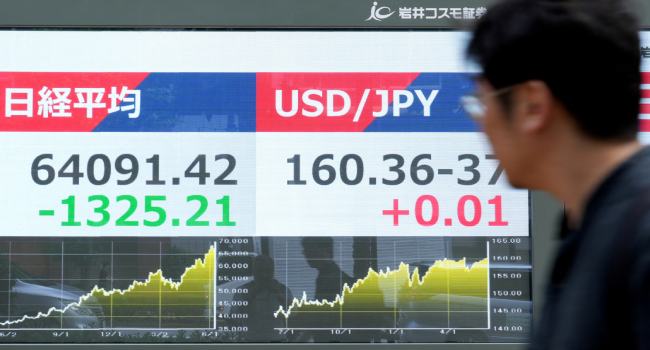
Stock markets mostly fell on Wednesday as fresh strikes in the Middle East, a jump in US inflation and a tech sell-off weighed on sentiment.
Data showed US consumer inflation surged to a fresh three-year high in May, hitting 4.2 per cent year-on-year.
The increase, up from April’s 3.8 per cent figure, follows strong US jobs figures last week that ramped up expectations for a rate hike.
Analyst Stephen Innes noted that the data was not as worrying as it first appears.
READ ALSO: US Consumer Inflation Hits Fresh Three-Year High In May
While the headline figure jumped, the core reading that excludes energy prices that have surged due to war in the Middle East held steady at 2.9 per cent.
“The inflation fire is burning, but it has not yet jumped every fence in the neighbourhood,” he said.
This “gave the market the narrow escape hatch it needed”, he added.
US stock futures pared loses following the release of the report, but Wall Street’s main indices still opened lower when trading opened.
Briefing.com analyst Patrick O’Hare said, “This report was by no means a game-changer in terms of the prevailing view that the Fed won’t be cutting rates anytime soon.”
However, investors have started worrying recently more about the risk of a hike in rates.
“While today’s report was in line with expectations, that doesn’t mean inflation risk — or the risk of rate hikes — is off the table,” said eToro investment analyst Bret Kenwell.
“Investors have recently woken up to that possibility, and all eyes will now turn to the Fed and its new chairman next week,” he added.
New US Federal Reserve Chair Kevin Warsh will preside over his first rate-setting meeting of the central bank’s policymakers next week.
Investors see no chance of a rate hike next week, according to the CME FedWatch tool, but that rises to roughly a third in September.
Technology shares led declines across Asia as investors weighed lofty valuations and concerns that persistent inflation could prompt the US Federal Reserve to hike interest rates.
European equities mostly followed Asia lower.
Oil prices rose only modestly despite the US and Iranian forces exchanging fire, just hours after President Donald Trump said a deal to reopen the Strait of Hormuz was close.
“The oil market is trading on hope that a resolution can be found, and on a loosening of oil supply,” said Kathleen Brooks, research director at trading group XTB.
She noted that declining onshore Middle Eastern oil inventories suggest “a significant amount” of oil is leaving the Gulf, although exports remain well below pre-war levels as the Strait of Hormuz remains largely blocked.
“This supply boost explains why the oil price is not surging on the latest outbreak of fighting in the Gulf,” she said.
Data from the maritime tracking firm Kpler showed Wednesday that the first Europe-bound oil tanker managed to get out of the Gulf at the end of last month.
Key Figures At Around 1330 GMT
New York – DOW: DOWN 0.5 percent at 50,623.33 points
New York – S&P 500: DOWN 0.5 percent at 7,353.09
New York – Nasdaq Composite: DOWN 0.6 percent at 25517.46
London – FTSE 100: FLAT at 10,226.10
Paris – CAC 40: DOWN 0.3 percent at 8,181.32
Frankfurt – DAX: DOWN 0.6 percent at 24,278.51
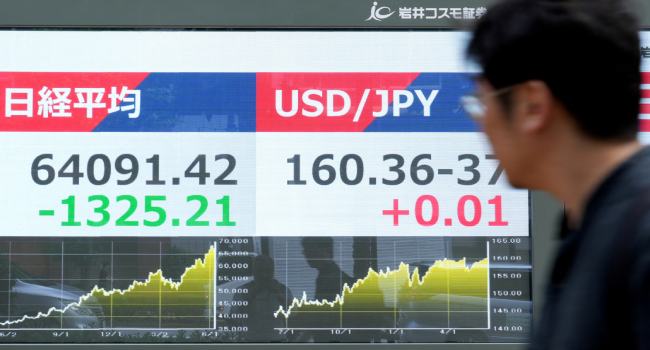
Tokyo – Nikkei 225: DOWN 1.9 percent at 64,179.27 (close)
Hong Kong – Hang Seng Index: DOWN 0.6 percent at 24,407.96 (close)
Shanghai – Composite: DOWN 0.4 percent at 3,993.23 (close)
Euro/dollar: UP at $1.1558 from $1.1542 on Tuesday
Pound/dollar: UP at $1.3404 from $1.3382
Dollar/yen: UP at 160.42 yen from 160.39 yen
Euro/pound: UP at 86.26 pence from 86.25 pence
West Texas Intermediate: UP 1.2 percent at $89.29 a barrel
Brent North Sea Crude: UP 1.0 percent at $92.38 a barrel
AFP