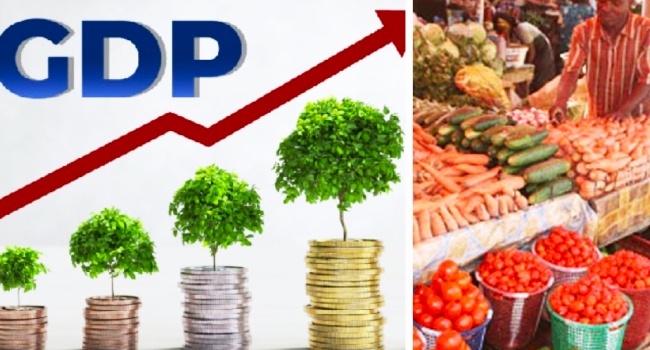
Nigeria’s latest Gross Domestic Product (GDP) numbers offer a measure of progress, but the bigger economic question is no longer simply whether the economy is growing. It is whether that growth can travel from balance sheets and macroeconomic indicators into the kitchen, the marketplace, the factory floor, and the pockets of ordinary Nigerians.
The question has become increasingly important as Nigeria moves through a period of sweeping economic reforms. The latest evidence is encouraging: the economy grew by 4.43 per cent in the second quarter of 2026, up from 4.23 per cent a year earlier, with agriculture, manufacturing, oil and gas and services all recording growth.
Nominal GDP rose to ₦119.27 trillion, an 18.43 per cent increase from the same period in 2025.
But GDP, by itself, does not tell the complete story. The real measure of economic progress is what those numbers eventually mean for incomes, prices, jobs, businesses, and household purchasing power.
The Foundation Is Shifting
The Q2 performance follows a year of strengthening economic indicators. Nigeria entered 2026 after recording 3.98 per cent real GDP growth in Q3 2025, while Q1 2026 growth reached 3.89 per cent, driven largely by the non-oil economy. Agriculture, telecommunications, trade, manufacturing, finance, real estate, construction, and transportation all contributed to Q1 expansion.
The foreign exchange position has also strengthened. In March 2026, the Central Bank of Nigeria said net foreign reserves increased by 772 per cent, from $3.99 billion at the end of 2023 to $34.80 billion at the end of 2025, while gross external reserves stood at $50.45 billion in February 2026. The CBN attributed the improvement to greater transparency and credibility in FX management, stronger inflows, and better reserve management.
In May, S&P raised Nigeria’s credit rating, citing fiscal reforms, foreign exchange gains, and stronger external reserves. The agency noted that reserves had risen to about $50 billion by March 2026, from about $33 billion in 2023.
These are important foundations because a more stable currency market, stronger reserves, and improved investor confidence can make it easier for businesses to plan, invest, and expand.
Revenue Meets Production
The next challenge is converting stronger public finances into productive economic activity.
On Wednesday, Governor Uba Sani of Kaduna, one of Nigeria’s largest commercial hubs, said that national tax revenue rose to ₦21.6 trillion in the first half of 2026.
“In the first half of 2026 alone, revenue reached approximately ₦21.6 trillion, representing a 49 percent increase over the corresponding period of the previous year,’’ he said at the 160th edition of the Joint Revenue Board meeting held in Kaduna.
The new tax architecture, which took effect in January, is intended to make the system more coherent and predictable while expanding the tax base rather than placing heavier pressure on existing compliant taxpayers.
That approach reflects the wider argument behind the reforms: the government needs more reliable revenue, but the economy also needs businesses and citizens capable of generating higher income.
The same principle is evident in the oil sector. In August, the Federal Government approved a new deep-offshore investment framework designed to unlock up to $50 billion in investment, beginning with the approximately $10 billion Bonga South West project. The framework seeks to provide investors with greater certainty while protecting long-term national value. Nigeria also recorded combined crude and condensate production of about 1.67 million barrels per day in July.
Rather than viewing energy only as an export earner, the administration is increasingly stressing domestic value. President Tinubu has urged the Nigeria Liquefied Natural Gas (NLNG) to reduce gas flaring and convert wasted gas into economic benefits for Nigerians, linking resource development to domestic energy needs and household welfare.
Making Reform Feel Real
This is where the economic story becomes more complicated.
Inflation has moderated substantially from the levels recorded in 2024 and 2025. The headline inflation rate dropped from 15.91 per cent in June to 15.43 per cent in July, according to newly released data by the National Bureau of Statistics (NBS). But on a month-on-month basis, the food inflation rate in July 2026 was 5.56 per cent, up by 1.82 percentage points from June 2026 (3.75 per cent).
The Federal Government has acknowledged that the ultimate test is whether macroeconomic stability translates into microeconomic improvement.
“In the past three years, we tried to do the hard part by implementing the necessary reforms to stabilise the economy. Now, the economy is stabilised, and we have laid the foundation for a prosperous nation. We didn’t do the reforms to create challenges, but to ensure prosperity reaches all our people,” said Tinubu.
“The results of the efforts are becoming very clear to all: The Renewed Hope Agenda is working. Because of those tough decisions, today, Nigeria has trade surpluses. Our foreign reserves are at their highest in 17 years. Our credit rating has moved up several notches.”
The President said his administration is building roads, railways, and superhighways that will last for a long time, while investors who left are returning.
“Oil and gas production is increasing. And in our universities – for the first time in a long time – there are no strikes. Our children are in class. And through NELFUND, student loans are putting education within reach, and affordable credit is going to our civil servants through Creditcorp.
“In the next few weeks, we are addressing some of the challenges being faced by our vulnerable population by providing cheaper means of transport, ramping up food production and implementing various relief programmes that will touch lives at the grassroots,” the former governor of Lagos State said.
That focus is critical because the government itself has said the savings and fiscal space created by reform must ultimately support citizens. In August, Finance Minister Taiwo Oyedele said petrol subsidy removal had mobilised ₦15.8 trillion in resources for the federation between June 2023 and December 2025, with ₦10.4 trillion shared among states and local governments and ₦5.4 trillion received by the Federal Government.
From Numbers To Nigerians
The next phase, therefore, is about transmission: ensuring that stronger revenues finance productive investment; that higher oil output creates jobs and foreign exchange; that improved infrastructure lowers the cost of moving people and goods; that tax reform makes businesses more competitive; and that stabilising prices eventually improves real household purchasing power.
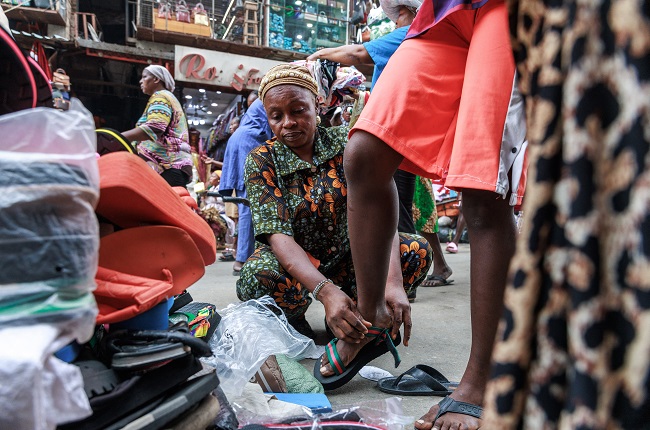
That is perhaps the direction articulated by the President: that the economy on his watch “is on the irreversible path to experience even more growth that all homes will feel at the dining table and in their pockets”.
“We are not resting on our oars. We are fully committed to translating consistent, stronger economic performance into better microeconomic outcomes for our citizens,” he added.
However, experts have their thoughts. The Chief Economist at SPM Professionals, Paul Alaje, recommends that President Tinubu establish a structured weekly or bi-monthly advisory forum with financial experts to compare official statistical figures against real-world economic conditions.
He cautions that because key metrics like GDP, inflation, and unemployment have been rebased—creating a potential “rebasing effect” that makes data appear overly favorable—government leaders must actively cross-check these numbers with practical market realities.
“So when you look at the number, they look good; in economics, there is what we call the rebasing effect — the
matter may not be as good as we think; it may not be as the number is suggesting,” he told Channels Television.
“If we look at it and compare what the number is saying with what is happening in the real economy, then we can see whether we are making progress or not, and I know
that government has capacity. Why? All the people in government came from us; we are the electorate. We are the ones that elected them to office, so it’s important for them to listen to us.”
The challenge ahead is therefore both simple and profound. Nigeria has spent the past three years trying to boost its economic foundations. The next measure of success will be how effectively those foundations support the lives built upon them.
For Nigerians, the promise of 4.43 per cent growth will mean much more when it becomes a better-paying job, a thriving business, cheaper transport, more affordable food, reliable energy, or greater opportunity for a young person.
That is when GDP stops being a number—and starts becoming a story Nigerians can feel.