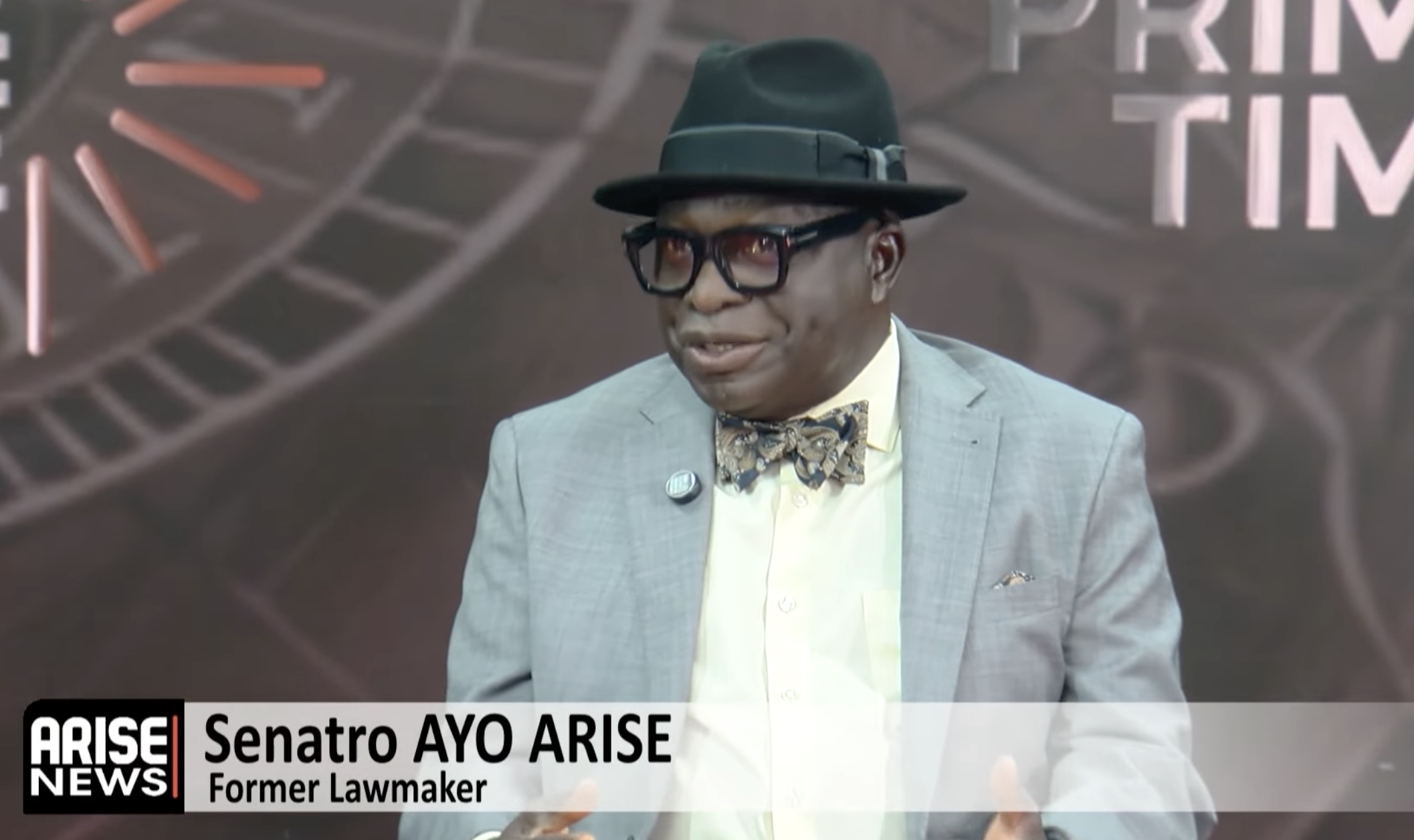
The former lawmaker representing Ekiti North senatorial district, Senator Ayo Arise, has described the result of the All Progressives Congress (APC) primary election in the district as a “cooked-up figure,” alleging that votes were not properly counted or announced at the various levels of the exercise.
Recall that Arise contested the APC primary for the Ekiti North Senatorial District ahead of the 2027 general elections, which was held on Monday, May 18, 2026, but rejected the outcome, alleging that the exercise was manipulated in favour of the incumbent Senator Cyril Fasuyi.
The former senator subsequently approached the court to challenge the outcome, insisting that the authentic results from the wards showed that he secured more votes than Fasuyi. Speaking in an interview on Arise News, Arise maintained that the figures announced by the APC did not reflect the votes cast during the primary.
” I was thinking the only way I was not going to win was if the results were just written, so I was prepared. I had drones and cameras everywhere—in all the wards. I was ready for them.
“True to what I suspected, these people just refused to count any vote. They went back, and now they have results. I don’t know where the results came from because they didn’t even bring papers to the election place. What I saw now is that they defeated me in my ward.
“In the places where we had elections, I had over 8,000 votes, and Cyril had about 7,000 across. That is what we presented to the court. What they wrote was about 10,000 votes for the incumbent senator. It was just a cooked-up figure; it was not even there.
“So we all knew it, and the video evidence is there if we only have the time to play it for the court to see. Everything has been itemized, documented, and submitted,” he told Arise News.

Explaining his decision to seek judicial redress, Arise said his action was aimed at correcting what he described as flaws in the party’s internal electoral process, stressing that the APC’s guidelines required the results to be announced at the ward, local government and senatorial levels.
“The reason why I went to court is basically that we need to correct our system. Whatever is wrong with it, we are responsible for the correction.
“Some people were deceived into thinking that the result was going to come from the headquarters, whereas the guidelines state that they must be announced at the ward level, local government level, and the senatorial level. That never happened.”
On consensus for the Ekiti North APC senatorial ticket, Arise said all aspirants must agree on the candidate, rejecting any imposed choice and insisting that the party should hold a primary where consensus fails.
He said the emergence of a candidate being presented as the “government candidate” led some people to believe that the outcome had already been decided, but he insisted that the choice should be determined through the votes of party members.
“The guidelines are there: go and follow it. You either go by consensus or direct primaries. I told them if we want to look at consensus, if you are not picking me, then we have to go to primaries—because I was so sure of the kind of confidence the people have in my ability to do more than I did before.
“The first criterion is everyone must agree. You must all agree to a consensus candidate. Where that does not take place, then you go for primaries. Because somebody was parading himself as the government candidate, some people tended to believe it, but I said no, we will sort this out on the field. That’s exactly what we did.
“Even if they succeed in court, I’m not sure they’re going to try that again. I will be satisfied internally that I’ve done what I’m supposed to do, and that the younger generation should be proud Democracy is about election—the choice of the people.”
On his appeal to President Bola Tinubu to intervene, Senator Arise said he was prepared to withdraw his case if the President personally asked him to step down, stressing that he regarded Tinubu as the leader of the party and was willing to heed his directive.
“Let me make myself very clear. When I was approached and they said President Tinubu said I should step down. If you take me to the President and he tells me, ‘Ayo, drop this thing,’ that will be the end of it. That’s what I meant, because he’s the leader of the party and I’m ready to listen to the leader of the party and the President of the country.”
He, however, said no such directive had been communicated to him, adding that he had already filed the suit 14 days after the primary as required and would continue to pursue the legal process pending the court’s decision.
“Nobody did that. So my going to court is an assurance that in case I got called up to drop the case—because you are voluntarily a member of a party, and whatever the leader of the party wants at the end of the day, if he appeals to you and you do not want to listen to him, then there will be no sympathy for you. But I’ve taken the legal process, I’ve gone to court, and I filed 14 days after the election as required. We are pursuing it; we are more than 80 days in.
“Even now, the only thing the President can do is say ‘drop the case, don’t run.’ It’s not like he can put me back in. But if I finish and I win in court, the court can say ‘this is the candidate,’ and that will supersede whatever else is already there. So that’s the way it is, and we’re waiting on that.”
On the broader challenges facing political parties, Arise said issues such as godfatherism, money politics, weak institutions and opaque primaries were not peculiar to the APC, stressing that his experience had strengthened his resolve to push for reforms within the party and ensure that its internal processes were properly conducted.
“This problem exists in all the parties. It has actually emboldened my resolve to ensure that things are done properly.”
Speaking on his relationship with President Bola Tinubu, Arise dismissed claims that the President had asked that he be kept away, stressing that he remained vocal about what he considered wrong within the party while maintaining his support for the President.
“Those who said the President told them so—I told them I don’t believe it, because there is nothing that would make the President say he doesn’t want Senator Arise. I believe he has more serious work on his hands in this country. I believe I can resolve this in court.
“I’ve made myself very clear, and that’s why I’ve been very vocal about this. I didn’t hide my feelings. I told them this is wrong, and it is wrong. We can’t continue our democracy without a strong internal democracy in it—to be an example for everybody to quote as to how things are supposed to go.”
On President Tinubu’s performance in office, Arise maintained that the President had fulfilled about 95 per cent of his campaign promises, explaining that his assessment was based on areas he had personally followed rather than a review of all 53 promises attributed to the President.
“He promised an economic turnaround for this country. There are a number of indices one can use. I can look at what he inherited: foreign reserves of about $30-something billion. Today, we are at $55.25 billion.
“This has made a lot of difference for Nigerians, because for the first time in 10 years, we are able to have the ability to pay for everything—machinery, equipment, goods, and services. We have 11 months plus of import cover. The difference is that people can set up factories, they can begin to get educated.
“For me, it’s not that everything is 100% perfect. My 95% might be based on the areas that I have been following and tracking. It might not be based on the premise of 53 promises, because I’m just hearing about 53 promises from you tonight; I didn’t monitor that.”
On the removal of fuel subsidy, Arise said he had always opposed the policy, arguing that its abolition under the Tinubu administration had freed up more revenue for states and reduced what he described as waste in the system.
“What I looked at: part of the problem that we had in the country was this fuel subsidy thing. I never supported it because I knew what was going on. The moment he came, the subsidy was gone. Now we have more money for the states. Some states, prior to 2023, owed salaries to their staff. How did they resolve that? Through stopping the subsidy and eliminating the waste.”
Favour Odima
Follow us on: