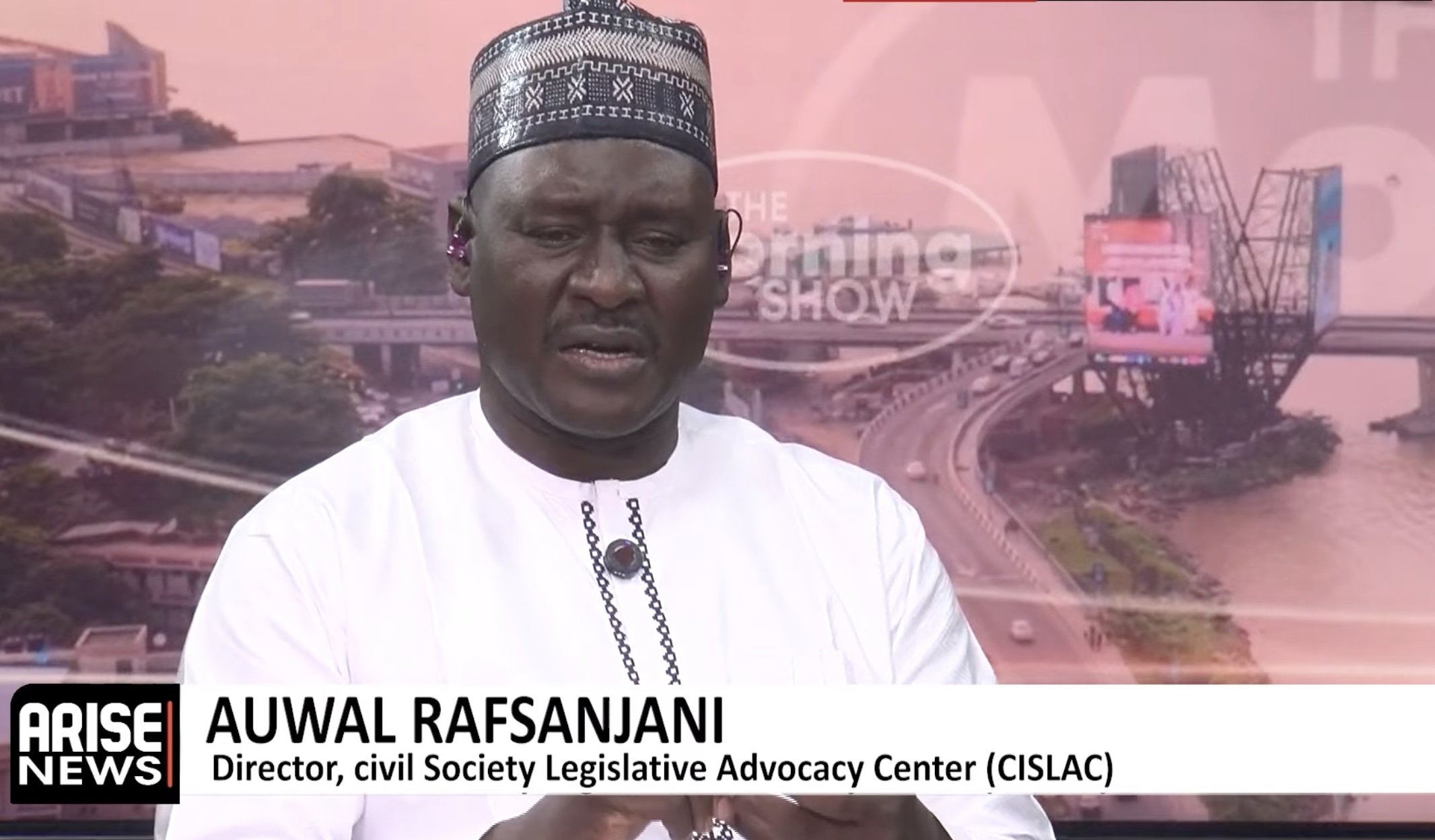
The Director of the Civil Society Legislative Advocacy Centre (CISLAC), Auwal Rafsanjani, has accused the National Assembly of attempting to restrict civil society organisations, media freedom and social media space ahead of the 2027 general election.
Speaking during an interview with ARISE NEWS on Thursday Rafsanjani said proposed legislative measures targeting civic organisations, digital platforms and media operations could weaken democratic participation and limit citizens ability to hold government accountable, explaining that civil society groups were not opposed to government but remained partners in strengthening governance, transparency and accountability.
“For example, you are told that as a media outlet, you must have offices in 36 states, including federal capital. This clearly is meant to actually, you know, stop people from helping to even spread what even governments are supposed to be doing, you know. I don’t think civil society and social media deserve this unnecessary punishment.”
Rafsanjani said civil society organisations had historically contributed to Nigeria’s democratic development by supporting institutional reforms. “Civil society organisation in Nigeria is interested in supporting government and National Assembly to ensure that we have legal frameworks that will improve transparency, accountability and good governance and we have been doing that to support barriers among governments, because civil society is not anti-government, we are not politicians and we are not agents of destruction, but rather partners in progress.”
He argued that rather than introducing restrictive laws, lawmakers should focus on reforms in critical areas such as security, budget accountability. “We expected the National Assembly to focus attention more on it. Issues around healthcare, education that have gone into coma. We expected the National Assembly to focus attention more on it.”

Rafsanjani also criticised what he described as unnecessary duplication of existing legal frameworks. “These two bills in particular that we are talking about, they are all covered largely under the existing legal frameworks that we have. If you talk about the anti-money laundering and terrorism, it is there. If you talk about EFCC’s compliance, it’s there. If you talk about the Financial Reporting Council, it is there. If you talk about the Corporate Affairs Commission compliance, it is there.”
He said imposing additional requirements on civil society organisations would create administrative burdens and could be used to weaken legitimate groups working in the public interest. “If you come up with this repressive legal framework to restrict civil society, even freedom of expression, freedom of movement and the ability to access resources to do the work that you do not even obligate because you are not even giving them the money.”
Addressing claims that tighter regulations were necessary to prevent foreign interference and illicit financial flows, Rafsanjani said he was unaware of any registered and compliant civil society organisation involved in activities against national security. “To the best of my knowledge, I have not come across any registered, complied civil society that is even being accused of receiving money for terrorism, receiving money to destabilise Nigeria, receiving money to do anything that is against our laws and our people.”
He challenged authorities to identify any organisation found to have violated the law rather than introducing broad restrictions affecting legitimate groups. “I’m not aware and if government has, government should actually publish and bring that organisation so that Nigerians can distinguish between those, you know, take, destabilise civil society organisations.”
Rafsanjani further dismissed concerns over foreign funding of civil society organisations. “This money, the foreign money that they are talking about, is not even up to 1% of the total money that the Nigerian government is actually budgeting, which, unfortunately, is not even being spent transparently, responsibly, as you can see scandal every now and then.”
He also accused some lawmakers of prioritising the introduction of bills for personal records rather than addressing pressing national issues.
“Some lawmakers, they just want to put it as a record that they have presented a bill, whether it succeeds or it doesn’t succeed, whether it makes sense or it doesn’t make sense.”
Rafsanjani warned that bypassing consultations with stakeholders during the legislative process could undermine democracy. “We are worried that if it is this kind of strategy that is going to apply to this, they may even pass it without having to hear the suggestion of civil society and other stakeholders, including the media on this proposed laws.”
He stressed that CISLAC would continue engaging with the National Assembly through advocacy and constructive dialogue. “We need National Assembly. If you don’t have National Assembly, you will have problems in our democratic journey because the National Assembly is supposed to ensure that they even expose corruption. They are supposed to ensure that they legislate and ensure that we have strong institutions that will respond to the yearning and aspiration of Nigerians.”
Rafsanjani added that while Nigeria needed an effective legislature, it did not need laws that would restrict freedoms and reduce civic participation. “We do not need repressive, retrogressive, contradictory laws that will come from there. And we don’t want also National Assembly to deprioritise national important issues.”
Erizia Rubyjeana
Follow us on: