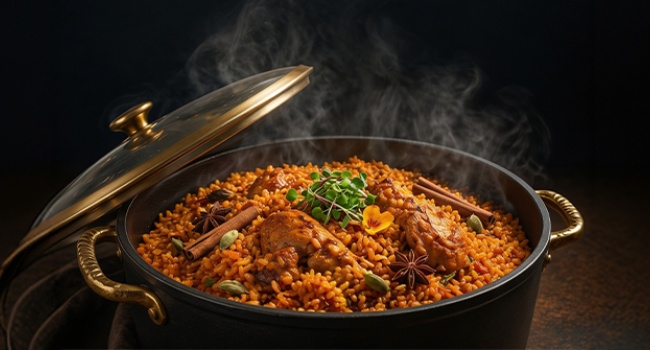
The average price of cooking a pot of jollof rice rose to ₦30,435 in March 2026, driven largely by global oil shocks linked to the Iran conflict, a report by the SBM Intelligence has revealed, showing a sharp escalation in Nigeria’s cost of living.
In its Jollof Index Q1 2026 report, the firm said the six-month increase of 19.4 per cent reflects the growing pressure on Nigerian households as fuel prices surge and transport costs ripple through food supply chains.
READ ALSO: Trump Orders US Navy To Destroy Boats Laying Mines In Hormuz
According to the report, the crisis was triggered by the escalation of conflict involving the US, Israel, and Iran in late February, which pushed global crude oil prices above $110 per barrel within weeks.
“After US and Israeli strikes on Iran on 28 February 2026, Brent crude spiked from the low-$70s to above $80 within days and then climbed to nearly $120 over the following month. For the Nigerian household, the Strait of Hormuz might as well lie at the end of the street.
“By mid-March, petrol in Lagos had nearly doubled to ₦1,325 a litre, and Abuja stations were posting ₦1,367. Diesel, the lifeblood of logistics, topped ₦1,500. Transport fares tripled on some routes,” it revealed.
Jollof Index
The report noted that Nigeria, despite being an oil producer, remains heavily dependent on imported refined fuel, making it highly vulnerable to global energy shocks.
SBM Intelligence explained that the Jollof Index, which tracks the cost of preparing a pot of jollof rice for a family of five, serves as a proxy for real household inflation.
“The national average cost of cooking a pot of jollof for a family of five rose 19.4 percent to ₦30,435,” it added.
The report added that the increase now places the cost of a single pot of jollof at over 40 per cent of Nigeria’s minimum wage, underscoring the severity of the affordability crisis.
Prices Surge Across Major Cities
The impact was uneven but widespread across the country.
Abuja recorded some of the highest prices, with the Wuse II market reaching ₦36,750.
Lagos saw the sharpest monthly spike, with prices jumping over 23 per cent.
Port Harcourt experienced the steepest six-month increase of 55.1 per cent.
The report attributed these increases to rising logistics costs, poor infrastructure, and insecurity along food supply routes.
Data from the National Bureau of Statistics cited in the report showed headline inflation rose to 15.38 per cent in March, while month-on-month inflation more than doubled to 4.18 per cent.
Food inflation remained elevated, particularly in rural areas where transport challenges intensified price increases.
The report highlighted widespread coping strategies among Nigerians, including reducing food portions, substituting protein sources, and switching from gas to charcoal for cooking.
“I use smoked dry fish now. Meat is too expensive,” a Lagos housewife told researchers.
It added that many households now buy food in small quantities, skip meals, or rely on backyard farming to manage costs.
Nigeria vs Ghana: Diverging Trends
The report also compared Nigeria with Ghana, noting a stark contrast.
While Nigeria’s food costs continue to rise sharply, Ghana’s have stabilised slightly despite similar exposure to global shocks.
“Stripped of currency illusions, Nigeria’s jollof pot now costs $21.93 — up from $14.49 in 2023. The index hit 151.3 in March 2026, its highest ever. Food inflation isn’t just rising, it’s hardening fast,” the report revealed.
SBM Intelligence further said that the Iran war merely exposed deeper structural weaknesses in Nigeria’s economy, including dependence on fuel imports, weak logistics infrastructure, and insecurity in food-producing regions.
“The jollof pot has become the most honest ledger of policy failure and household resilience,” it stated.
The firm called for urgent reforms, including investment in transport infrastructure, strategic reserves, and agricultural systems to cushion future shocks.