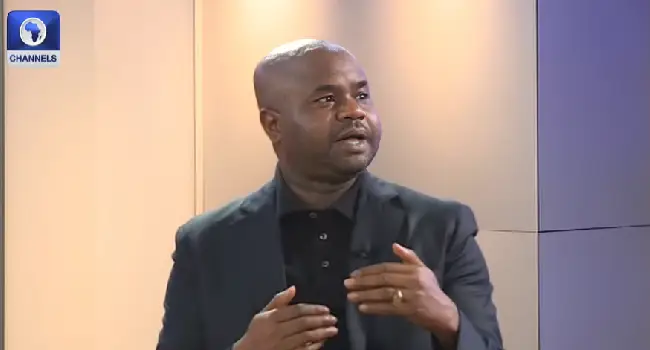
The Chairman of the Nigeria Revenue Service (NRS), Zacch Adedeji, has said the government’s tax reforms are not designed to extract more money from Nigerians but to create an environment in which businesses and individuals can prosper.
Adedeji said the focus of the NRS was to tax prosperity rather than poverty, stressing that increased revenue would naturally follow when businesses and individuals perform better.
He spoke in an exclusive interview on Channels Television’s Sunday Politics programme.
Responding to concerns about the state of the economy, particularly amid weak household incomes and high levels of poverty, Adedeji said the revenue service was not focused on extraction.
“We are not there to extract, and that is Mr President’s policy. Honestly, our focus is not revenue. If you remember, Mr President’s cliché is that I am to tax prosperity. I don’t want to tax poverty. I’m to tax the fruit, not the seed, and I’m to tax the return, not investment.
“So, for us, it’s not extracting. We are not there to extract. And that is why Mr President is creating a conducive economic environment,” he said.
READ ALSO: Subsidy Removal Best Thing To Happen To Nigeria, Tinubu Deserves Commendation — NRS Chairman
Adedeji explained that the revenue service’s interest was directly linked to the performance of businesses and individuals, saying higher earnings would translate into higher tax receipts.
“When business does well, the Nigerian revenue will do well, so we are not there to extract. That is not our focus. That is why you see more of my job as Chief Tax Officer is to make sure that businesses are doing well, because if you make 100 naira, I will take 30 naira. If you make 200, I will take 60. If you make 300, I will take 90.
“So, if I want to make more, I must work for you to make more. And that is why it is in the best interest of us in the Nigeria Revenue Service that businesses are doing well and individuals are doing well,” he said.
The NRS chairman also linked the government’s economic reforms to efforts to remove obstacles to business growth, citing reforms in the power sector and increased allocations to state governments.
He said states had a critical role to play in reducing poverty because of their proximity to the people, particularly in areas such as primary and secondary education. He also cited the establishment of the Nigerian Education Loan Fund (NELFUND) as part of the Federal Government’s intervention in areas that could help people improve their economic prospects.
“For us in Nigeria Revenue Service, it’s not about extracting. It’s about making the country prosperous. Mr President has said it publicly. We are not here to tax poverty. We are here to tax prosperity. That is what our duty is, to make sure people prosper. That is our responsibility,” he said.
Revenue, Budget Releases
On criticism that increased government revenue had not translated into corresponding capital expenditure, with some lawmakers raising concerns about budget implementation and the carry-over of projects, Adedeji said revenue generation and budget expenditure were separate issues.
He said there was a “total difference” between the budgeting system and the expenditure framework, urging critics not to conflate the two.
“No, and that is the understanding that people should get. There is a total difference between the budgeting system and the expenditure framework,” he said.
Adedeji cited major infrastructure projects, including the Lagos-Calabar Coastal Highway and the Sokoto-Badagry Superhighway, as examples of projects being pursued by the administration.
He further stressed that the revenue collected by the NRS should not be viewed entirely as money available to the Federal Government, noting that a significant portion of federation revenue is shared with the states.
Tax System
Adedeji’s comments come against the backdrop of Nigeria’s new tax regime, which took effect on January 1, 2026, replacing several existing tax laws with four principal pieces of legislation covering taxation, tax administration, revenue collection and taxpayer disputes.
Under the new regime, individuals earning up to ₦800,000 annually are exempt from personal income tax, while higher earners are subject to progressive rates of up to 25%. Eligible workers can also claim limited rent relief.
For businesses, small companies with annual turnover below ₦100 million are exempt from Companies Income Tax, while larger companies generally pay 30% CIT alongside a 4% development levy. Large multinational companies are also subject to a 15% minimum effective tax rate.
The Value Added Tax rate remains 7.5%, while basic food items, medicines, healthcare and education are among essential goods and services that receive zero-rating.
The reforms also expand capital gains taxation to cover assets including cryptocurrencies and other digital assets, while introducing stricter compliance measures such as the use of the National Identification Number as a Tax Identification Number.