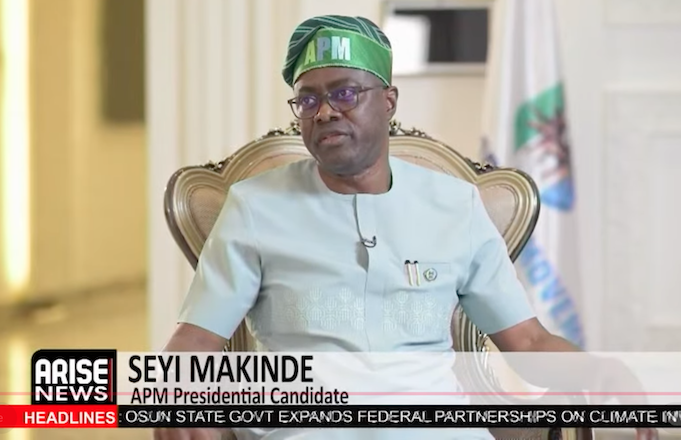
Oyo State Governor Seyi Makinde has accused President Bola Tinubu of reneging on a signed agreement to establish a government of national unity, revealing that the understanding formed the basis of his controversial decision to support the All Progressives Congress (APC) presidential candidate in the 2023 election.
Makinde, who is positioning himself for a possible presidential contest in 2027, disclosed that the agreement was documented and signed, insisting that he retained a copy as evidence of the understanding reached before the election.
Speaking in an exclusive interview with ARISE News anchor Ojy Okpe, the governor maintained that his decision to back Tinubu, despite belonging to the opposition Peoples Democratic Party (PDP), was driven by the expectation of an inclusive government rather than ethnic solidarity.
“I still have the agreement with us,” Makinde declared while explaining the circumstances surrounding his support for Tinubu three years ago.
The governor alleged that the President failed to fulfil the commitment after assuming office, raising questions about the political understanding that preceded the 2023 presidential election.
“I’ve had a certain experience with him, you know, where agreement was signed. And he didn’t keep to it,” he said.
Makinde’s disclosure offers a new explanation for his decision to support Tinubu in the election, a move that placed him at odds with sections of his party and generated controversy over his political allegiance.
He insisted that the arrangement was intended to produce a government that would accommodate different political interests and promote national inclusion, rather than merely secure electoral victory for an individual candidate.
According to the governor, the critical issue was whether the agreement delivered the inclusive administration that had been envisaged.
“Tell us if the agreement was fulfilled. That’s wrong. Tell us if, not in terms of something personal, what has Nigeria got out of this? Are we having a government of national unity right now?” he asked.
Makinde maintained that his disagreement with Tinubu should not be interpreted as personal hostility, arguing that his position was informed by his assessment of the administration’s performance and the direction of the country.
He said the failure to implement the alleged agreement had influenced his political judgment, particularly as opposition leaders explored possible alliances ahead of the 2027 presidential election.
Asked whether he would consider working with Tinubu again as political realignments gathered momentum, Makinde contrasted his experience with the President with his dealings with former Vice President Atiku Abubakar and former Labour Party presidential candidate Peter Obi.
“I’ve not had that issue with him before, with Atiku Abubakar, or H.E. Peter Obi,” he stated.
The governor’s remarks suggested that his reservations about renewed political cooperation with Tinubu stemmed from what he considered a breach of trust rather than an unwillingness to engage with politicians across party lines.
Makinde also rejected suggestions that his support for Tinubu in 2023 was motivated by their shared Yoruba ethnic background.
He argued that the decision was based on the proposed government of national unity and his belief that such an arrangement could advance Nigeria’s interests.
The governor further maintained that backing Tinubu in Oyo State represented a significant political risk to his own re-election campaign, as he could not predict how voters would respond to his support for a presidential candidate from a rival party.
He said he made the decision without knowing whether it would strengthen or undermine his chances of securing another term as governor.
Makinde’s account places renewed attention on the political arrangements surrounding the 2023 presidential election and the expectations of opposition figures who supported Tinubu despite their party affiliations.
However, the governor did not disclose the full contents of the alleged agreement during the interview, including the identities of all its signatories or the specific arrangements contemplated for the proposed government of national unity.
The document was also not independently examined during the interview.
Beyond his disagreement with Tinubu, Makinde addressed ongoing discussions among opposition politicians seeking a common platform ahead of the 2027 election.
He advocated a broader opposition arrangement, maintaining that any political alliance should be guided by Nigeria’s interests rather than the personal ambitions of individual politicians.
The governor indicated that consultations among opposition figures were continuing, although he did not announce a final agreement or identify a settled political platform.
His remarks come amid discussions over opposition cooperation ahead of the next presidential election, with political leaders considering how to reconcile competing interests and ambitions.
Neither the Presidency nor Tinubu responded during the interview to Makinde’s allegations concerning the purported written agreement.
Demola Ojo
Follow us on: