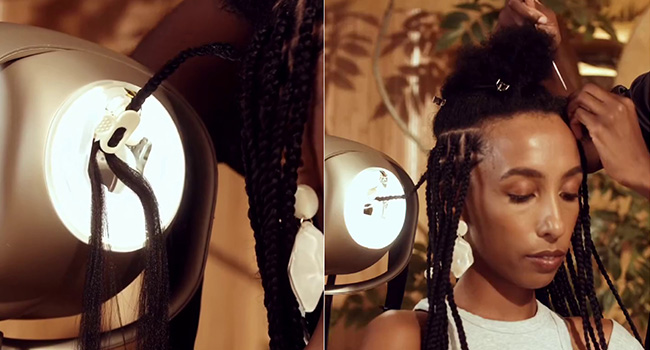

Nigerian-American engineer and entrepreneur Yinka Ogunbiyi has officially shared a demonstration of HaloBraid on social media, offering a first-ever look at the device performing the mechanical weaving process on hair.
The company captioned the viral reveal: “Meet HaloBraid. The first ever look at the viral hair braid assist device.” According to the startup, the technology is engineered to help professional stylists complete individual braids up to five times faster, allowing salons to scale their client capacity while maintaining precision.
The concept for HaloBraid originated during the COVID-19 pandemic lockdowns in 2020, when Ogunbiyi spent four days braiding her own hair. Recognising the immense time commitment and physical toll required for traditional styles, she partnered with co-founder David Afolabi to design a mechanical solution.
Ogunbiyi moved to the United States to complete joint master’s degrees at Harvard Business School and the Harvard John A. Paulson School of Engineering and Applied Sciences. Utilising pitch competitions to fund early development, her engineering team built over 600 prototypes and filed 12 patents.
The venture gained significant momentum in July, when the startup closed a $7 million seed funding round led by Seven Seven Six, the venture capital firm founded by Reddit co-founder Alexis Ohanian. The company currently reports a commercial waiting list exceeding 7,000 salons.

Not Replacing The Stylist
A central question surrounding the demo is how the machinery interacts with human labour. The company has clarified that HaloBraid is designed strictly as an assistive tool rather than a fully autonomous replacement for human braiders.
Under the operational workflow, the human hairstylist retains full creative control: they section the hair, apply styling products, and manually initiate the root of each individual braid. Once the root is secured by hand, the strand is fed into the HaloBraid unit to handle the repetitive mechanical weaving motion, before the stylist finishes and seals the ends.
Ogunbiyi emphasises that the overall mission extends beyond mere efficiency:
“I believe time is the ultimate luxury. And even though this has been harder than I could have ever imagined, it’s worth it for me. I want to save eight billion hours for Black women each year.”
Public Reception: Health Benefits Versus Cultural Tradition
The public unveiling on Instagram generated immediate viral engagement, drawing thousands of reactions from stylists, tech enthusiasts, and consumers weighing in on the future of Afro-hair care technology.
Many commenters celebrated the potential health benefits for professional braiders who suffer from chronic occupational injuries like carpal tunnel syndrome and arthritis.
“I could see this reducing carpal tunnel in braiders, help disabled and older braiders who have lost hand strength, and get caregivers home to their families sooner,” one user wrote.
Conversely, cultural purists voiced scepticism regarding the integration of machinery into an ancestral practice.
“I have mixed feelings about this. Love the innovation, but braiding is an art,” one user shared. “This is a slippery slope to machines taking the human element away from hairdressing.”
Other observers raised practical questions concerning device maintenance, compatibility with mixed synthetic and natural kinky hair textures, and final retail pricing for salons.
As HaloBraid prepares for a phased commercial rollout involving selected stylists, the startup sits at the forefront of a shifting beauty landscape, testing how traditional markets adapt to robotic assistance.
STAY INFORMED
NAIJA CONNECT
Every week, discover the stories of progress at home and excellence around the world.
Channels Television
Get our top curated news and video highlights
Follow on WhatsApp
Channels Television
Join our official Telegram feed for real-time news updates
Join on Telegram