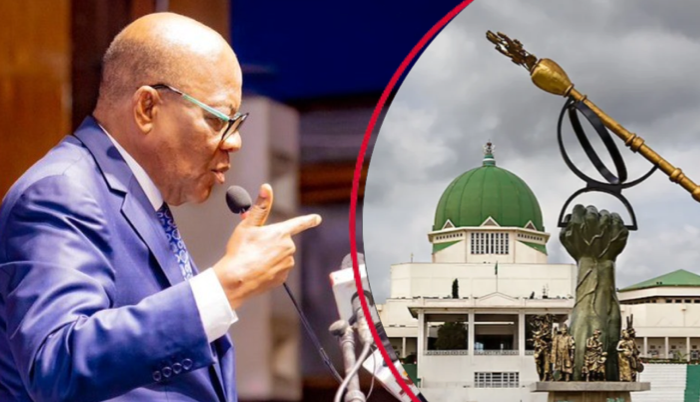
A former President of the Nigerian Bar Association (NBA), Dr. Olisa Agbakoba (SAN), has urged the National Assembly to urgently amend the Electoral Act to make electronic transmission of election results mandatory before the 2027 general elections.
Agbakoba warned that failure to give electronic transmission a clear statutory backing would prolong Nigeria’s cycle of disputed elections and protracted post-election litigation.
Real-time electronic transmission backed by statutory authority, he said, would significantly reduce disputes by creating verifiable digital records that are immediately accessible.
In a statement titled “Ending the Cycle – Why Electronic Transmission Should Be Enshrined in the Electoral Act Before 2027,” issued on Wednesday, he argued that Nigeria’s electoral framework remains burdened by legal uncertainty because key technological innovations lack express provisions in the law.
According to him, although the Electoral Act is amended before almost every general election, lawmakers have repeatedly failed to address what he described as a “fundamental defect”, the absence of clear and binding legal authority for real-time electronic transmission of results.
Agbakoba said the controversy that followed the 2023 general election exposed a major gap in the law.
While the Independent National Electoral Commission (INEC) deployed its Result Viewing (IReV) portal to upload polling unit results, the Supreme Court later ruled that electronic transmission was not expressly provided for in the Electoral Act 2022.
He noted that the apex court held that since electronic transmission was contained only in INEC’s Regulations and Guidelines, and not in the substantive provisions of the Act, it lacked binding legal force.
The court further ruled that the IReV portal was created primarily for public viewing and could not replace the legally prescribed collation process or automatically serve as admissible evidence in election petitions.
“The message was unmistakable. Without explicit statutory provision, electronic transmission remains optional and legally inconsequential, no matter how transparent or efficient it may be,” Agbakoba said.
He warned that the current legal position places an almost insurmountable evidentiary burden on petitioners challenging election results.
Citing the observations of the late Justice Pat Acholonu in Buhari v. Obasanjo (2005), Agbakoba recalled that the jurist had questioned whether any petitioner could successfully challenge a presidential election result under Nigeria’s legal framework.
The case involved former President Muhammadu Buhari and ex-President Olusegun Obasanjo.
Justice Acholonu had observed that a petitioner would need to call hundreds of thousands of witnesses from polling units across the country to prove irregularities, a task he described as practically impossible within the strict timelines prescribed by law.
Agbakoba said that prediction has “proven tragically accurate,” noting that no presidential election petition has succeeded since Nigeria’s return to democratic rule in 1999.
With over 176,000 polling units nationwide, he argued, the manual method of proving discrepancies unit by unit makes the burden of proof nearly unattainable.
Drawing a historical comparison, Agbakoba referenced the June 12, 1993 presidential election, widely regarded as one of Nigeria’s most credible polls.
Conducted under the Option A4 system, the election allowed open counting and immediate verification of results at polling units in the presence of voters and party agents.
Despite being manual, the process generated widespread public confidence due to its transparency, he said.
The election, won by the late Moshood Abiola, was later annulled by the military government but remains a benchmark for electoral credibility in Nigeria’s democratic history.
“If manual transparency could achieve such credibility in 1993,” Agbakoba argued, “imagine the transformative impact of real-time electronic transmission in our digital age. It would combine immediate verification with secure digital records, delivering transparency with greater efficiency and verifiability.”
He described the ongoing legislative review process as a “monumental opportunity” for the National Assembly to correct the defect in the Electoral Act ahead of 2027.
Embedding mandatory real-time electronic transmission of results in the law, he said, would eliminate ambiguity, close legal loopholes and reduce post-election litigation.
Agbakoba cautioned that without reform, Nigeria risks perpetuating what he termed a “vicious cycle”, of elections followed by widespread disputes, lengthy judicial battles and recurring amendments to the Electoral Act.
“Our democracy demands certainty, transparency and enforceability. Anything short of express statutory backing for electronic transmission leaves the process vulnerable to controversy,” he said.
He stressed that while INEC has introduced digital innovations, administrative guidelines cannot substitute for the authority of an Act of Parliament.
Wale Igbintade
Follow us on: