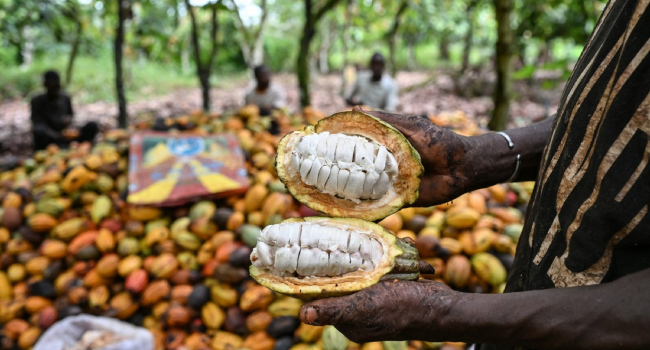
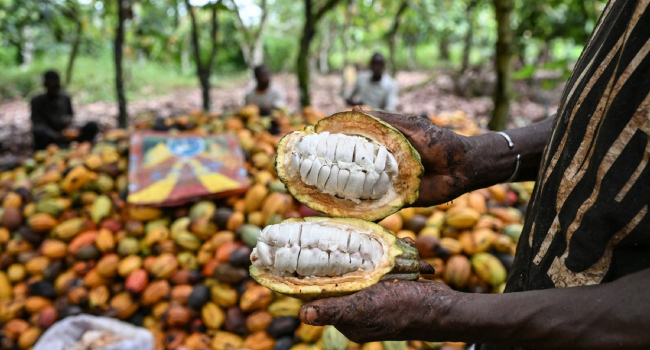
After soaring for two years, cocoa prices have largely fallen back this year, but without any impact on chocolate prices, just days before the holiday season. Côte d’Ivoire and Ghana are the main suppliers of cocoa pods—the fruit of the cacao tree—from which the cocoa beans used to make chocolate are extracted. These two West African countries account for more than half of global production, with most of the remainder coming from Nigeria, Cameroon, as well as Ecuador, Indonesia, and Brazil.
Nigeria recorded non-oil exports growth of 21 per cent to $12.8 billion in 2025, driven by policy reforms under the Federal Ministry of Industry, Trade and Investment.
Boosted by improved export processes, targeted trade reforms, and growing value addition across key non-oil sectors of the economy, the review by the Ministry noted that the performance reflected a broader expansion in trade activity, with overall trade value rising by 14 per cent.

The gains were outlined in the ministry’s 2025 review of its activities and priorities for 2026, a document that assessed Nigeria’s economic repositioning under the current government.
“The year 2025 marked a defining phase in Nigeria’s economic repositioning under the Renewed Hope Agenda of President Bola Ahmed Tinubu, GCFR, with the Federal Ministry of Industry, Trade and Investment (FMITI) delivering critical reforms and results that deepened industrial capacity, expanded exports, and restored investor confidence.
“Non-oil exports grew by 21 percent, reaching $12.8bn in H1 2025, nearly double the $6.5bn target and contributing to a N12trn trade surplus during the same period,” the trade ministry said.
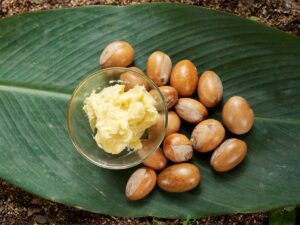
The review highlighted that Nigeria’s leading non-oil exports during the period included cocoa and cocoa derivatives, sesame seeds, cashew nuts, shea butter, ginger, hibiscus flower, rubber, palm oil derivatives, fertilisers, cement and clinker, as well as liquefied natural gas.
Export capacity was further strengthened through a partnership with the Nigerian Export Promotion Council (NEPC), with 27,352 exporters trained, 200 MSMEs certified for international trade, and 3,047 farmers supported with hybrid seedlings.

(Photo by Ifiok Ettang / AFP)
The ministry also noted the Women Export Fund, which expanded access to trade finance for women-led enterprises, attracting over 67,000 applications and awarding grants to 146 women-led enterprises.
“Nigeria’s Special Economic Zones generated over $500m in export revenues and created more than 20,000 direct jobs, reinforcing their role as engines of export-led growth, industrialisation, and employment generation through the Nigerian Export Processing Zones Authority (NEPZA) and the Oil and Gas Free Zones Authority (OGFZA),” the ministry added.
The review said the ministry, in 2025, recorded significant progress in investment attraction, adopting a systems-driven approach that improved project visibility, reduced information gaps, and strengthened the bankability of investment pipelines.

READ ALSO: NERC: International Customers Owe Nigeria ₦25bn For Electricity
The new approach delivered measurable outcomes, with four priority investment projects valued at $13.7 billion progressing to advanced stages, representing a conversion rate of over 25 percent from $50.8 billion in signed Memoranda of Understanding.
The ministry said it recorded a decisive turnaround in investment attraction, responding strategically, rather than reactively, to global economic headwinds and clearly signalling that Nigeria is open for business.
Through structured deal origination, the Ministry added that it built a de-risked investment pipeline exceeding $5 billion across priority sectors, using targeted roadshows, curated deal rooms, and coordinated investor engagement to convert opportunities into bankable projects.
Non-oil exports showed significant growth in 2025, reaching record highs like₦9.2 trillion in the first nine months, a 48% jump from the previous year, driven by naira devaluation making goods competitive.
Key exports include cocoa, urea/fertiliser, and cashew nuts, with agricultural commodities dominating, though diversification into semi-processed goods is occurring, despite ongoing challenges like infrastructure and port inefficiencies.
Key Figures & Trends (2025 Data)
- Record Performance: N9.2 trillion in the first nine months of 2025, surpassing the entire N3.1 trillion value for 2023.
- H1 Growth: Up 19.6% to $3.25 billion in the first half of 2025 compared to H1 2024.
- Top Products (H1 2025): Cocoa beans (34.88%), Urea/Fertilizer (17.65%), Cashew Nuts (12.35%), Sesame Seeds (4.23%).
- Increased Diversification: Exported 236 distinct products in H1 2025, up from 202 in H1 2024, showing a gradual shift beyond raw agricultural products.
Driving Factors
- Currency Reforms: Devaluation of the Naira in 2023 made Nigerian products cheaper and more attractive globally.
- Policy Support: Initiatives from bodies like the Nigerian Export Promotion Council (NEPC) are boosting exports.
Challenges
- Infrastructure Deficits: Poor roads, unreliable power, and port congestion hinder smooth trade.
- Bureaucracy: Multiple agencies, complex documentation, and fees create bottlenecks.
- Processing Gaps: Continued export of raw, unprocessed goods limits higher earnings.