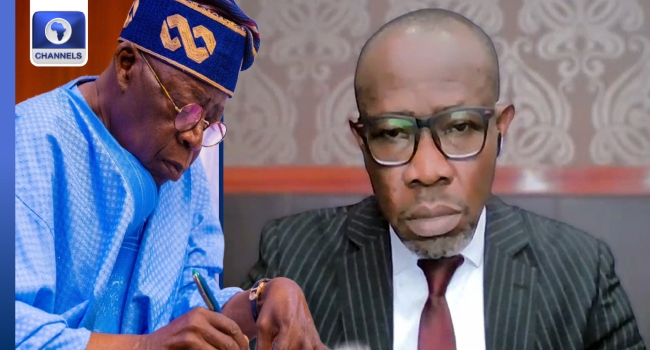
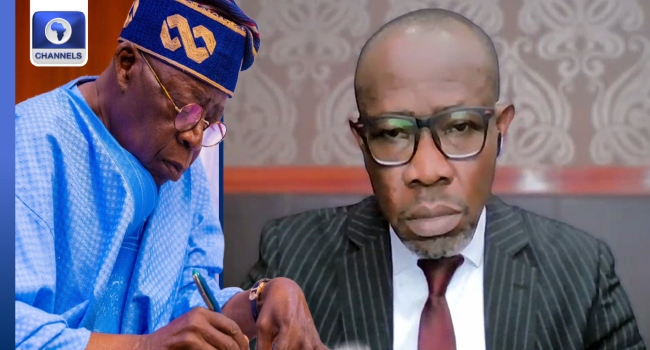
Professor of Economics, Lagos Business School, Bongo Adi, has described President Bola Tinubu’s $6.9 billion foreign loan as a means for poverty alleviation in the country.
Adi said this on Wednesday, during an interview on Channels Television’s The Morning Brief.
The National Assembly on Tuesday approved President Tinubu’s request for a $6.9bn foreign loan facility, with a key provision mandating that 40 per cent of the funds be channelled towards capital projects in the 2025/2026 budgets.
The approval followed the consideration of a report by the Senate Committee on Local and Foreign Debt, which recommended the allocation to ensure the loan directly supports infrastructure and development projects.
“Let’s bring it down to the translation of that borrowing, to raise sector development on poverty alleviation. You will agree that the level of poverty we are currently confronting in Nigeria is at levels we have never seen in our history.
“So what I can see is that this government seems to be supervising the highest level of poverty in our country’s history”, Adi said on the breakfast show.
He noted that the government is also a rational agent just like individuals, “so they are looking at how to maximise their returns at the least cost
“For the government, I think their maximisation problem is to borrow as much as they can. Given their physical situation, they make it seem to speak in their favour.
“You have an external reserve of 50 billion, so everybody, even the creditors, has confidence that this government can repay.”
READ ALSO: Tinubu Seeks NASS Approval Of ₦9trn Increase To 2026 Budget
According to the economist, the government does not care about the interest from borrowing because it is carried over to successive administrations.
He cited the instance of loan repayment of 5 to 10 years, saying that the government will be out of power by then.
“So you can see that everything speaks in the direction of more borrowing. You can’t stop it because, given the rationality at play here, I think the rational choice is for the government to borrow,” he stated.
READ ALSO: NASS Approves Tinubu’s $6.9bn Foreign Loan Request
He further explained that the macroeconomy and physical reforms seem to be yielding returns.
“Given the time lag, again with the collapse of infrastructure, it begins to appear that the time lag keeps retracting, and we begin to see the cascade to the micro level to the ordinary man or woman on the street.
“So this is the challenge that we have, currently the misery of the population is exacerbating, and that’s why people are not so happy when they hear the government is borrowing more money.
“What can you say to that when there is no light and productivity is at an all-time low, even though at the macro front, we seem to be doing well. Most of that is driven by the development in the oil sector, but it is still underperforming,” he added
However, Adi noted that the masses are still feeling the rhythm of the aftermath of the removal of the oil subsidy and the harmonisation of the exchange rate.