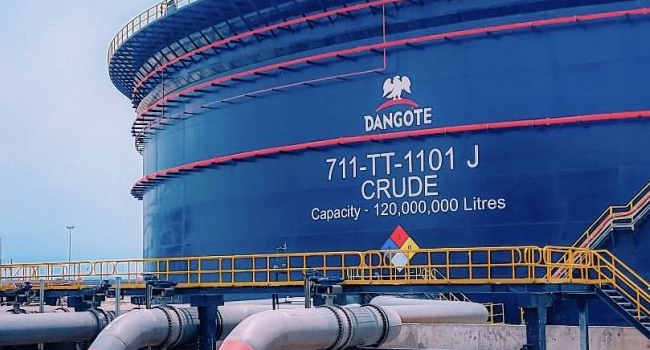
Oil markets are beginning to show support for the Dangote Refinery taking full control of the local market supply of Premium Motor Spirit (PMS) or petrol, after vehemently kicking against a monopolistic market for most of 2025.
The move followed a continued crisis in the Middle East, which had weighed negatively on crude prices, making importation impossible, and sent petrol market prices above ₦1, 000 per litre in recent times.
Brent had reached above $100 per barrel before crashing to about $88 per barrel on Tuesday.
The increase in crude price had initially forced the Refinery to increase gantry price to ₦1,175 per litre last week, before slashing it down to ₦1,075 per litre on Tuesday, representing a ₦100 drop.
Filling stations nationwide had responded to the initial increase and adjusted pump prices to between ₦ 1,200 and ₦1,300, and above, depending on the area.
However, Dangote Group’s Chief Communications Officer, Anthony Chiejina, told Channels Television on the phone Tuesday that petrol at the gantry will now be sold at ₦1,075 per litre, while those supplied through coastal distribution will sell at ₦1,050 per litre.
The Refinery said the price of diesel has also been reduced to ₦1,430 per litre, representing a ₦190 drop from the prior price of ₦1,620 per litre.
“Under the revised pricing structure, the gantry price of PMS has been reduced from ₦1,175 to ₦1,075 (₦100) per litre, while the coastal price has been lowered from ₦1,150 to ₦1,028 (₦122) per litre. The price of diesel has also been reduced from ₦1,620 to ₦1,430 (₦190) per litre,” the refinery said.
The refinery explained that the move reflected global oil prices.
Reacting to the development, National President of the Petroleum Products Retail Outlets Owners Association of Nigeria (PETROAN), President, Dr. Billy Gillis-Harry, while appearing on Channels Television’s The Morning Brief on Wednesday, noted that Nigeria stands to benefit if the Refinery supplies “100 per cent” petrol consumed locally.

His comment was after he tagged the Dangote Refinery “our salvation”, especially as the Iran war escalated and showed no sign of abating. According to him, higher petrol price was a better option than scarcity.
READ ALSO: Iran War: Dangote Refinery Is Our Salvation, ₦1,500/Litre Petrol Better Than Scarcity, Marketers Tell Nigerians
“As I said, let us be grateful first to God and Dangote for taking the investment foresight by establishing the Dangote Refinery.
“Going by the war, I don’t know what we would be doing today in Nigeria if we did not have that facility in place.
“Right now, marketers source all of our products from Dangote Refinery. Whether we are going to buy from depots that have not started selling to us in a very long time, we expect that with effective stakeholders’ collaboration, the Dangote Refinery’s objectives will be met.
“If Dangote has to have 100 per cent of the domestic retail outlets, it is only for the benefit of Nigeria.
“While we were talking about this a couple of months ago, we indeed had to have other sources of petrol supply. But today, that is not the case especially with the war raging, making imports completely impossible until there is a resolution.
“So, we are taking our products from Dangote, whether it’s 50 per cent or 100 per cent. To every retailer, our concern is to meet our objective of ensuring that we supply products to end-users. Our services grew the economy daily by providing those critical services”, he said on Wednesday.
READ ALSO: FG Suspends Petrol Imports Over Boost In Local Production
Gillis-Harry noted pricing would always be determined by global market fluctuations.
“For pricing, we are aware that the market situation determines prices, and we have always said that prices will never be static. It will be up. It will be down. Price fluctuations are what we should expect in the coming days.
“Hopefully, an example of what Dangote did yesterday, to reduce petrol price by N100 per litre. Well, I don’t have any empirical reason for such a move, but “I believe that must be some fundamental changes in the production dynamics for him to have made such deduction, and we are happy about that.
“We hope the deduction will reflect in the pump as soon as we start buying new products”, he said.

While also speaking on The Morning Brief on Wednesday, Kelvin Emmanuel, an Economist/Oil & Gas Expert, also expanded on the reason for rising petrol prices
“The impact of the war on Dangote Refinery is that it sources crude from US, Brazil, and less than one million barrels from Senegal and Iran, and others.
“Dangote actually sources less than 50 per cent of his crude from Nigeria. I am aware that for March, NNPC had six cargoes benchmarked in US dollars, of about 5.7 million barrels for the month, which are going to the Refinery.
“The cost of the war and how it has added on Panama vessels, all machinery, insurances, PNI protection and indemnity, and war risk insurance. The cost of a typical vessel taking about one million barrels across the Atlantic to maybe Brazil has gone from about $40, 000 to about $80, 000 per day, minus what you have to pay to NIMASA and NPA as levies, and other costs”, he said.
Emmanuel advised the Federal Government to look into resolving issues around local crude pricing to reduce petrol prices.
“So these are the facts that the crude Dangote sources in Nigeria, he has to pay an extra premium that is not taxed by the Federal Government on it because operators don’t sell crude directly. They go through third parties, which is a contravention of the PIA.
“These are some of the issues that the Nigerian government has to look at, to ask if the Refinery is being supplied with crude in naira or dollars. Government has to talk about these issues as we address increase in prices.
“So if he has to source crude from other countries in the world, it affects his margins, and if he buys in Nigeria and pays at a benchmark, pays in dollars and pays extra premium that he doesn’t pay when he sources from abroad, it affects petrol price, which as at last night is 182 cents per litre, which is still even very low, compared that in the s, petrol sells for $1, 37 cent per litre”, he noted.