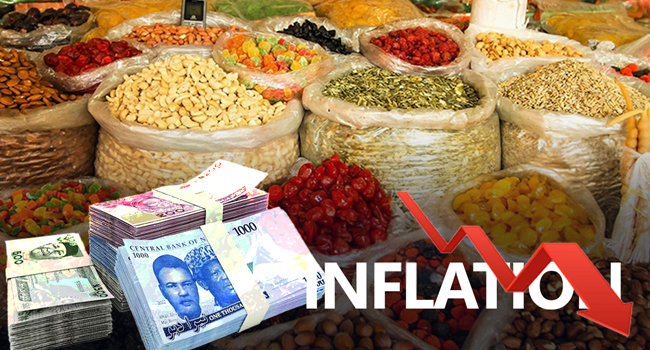

In what appears to be a continued, albeit slow, cooling of price pressures across the country, Nigeria’s headline inflation rate eased to 15.06 per cent in February 2026.
Data released on Monday by the National Bureau of Statistics (NBS) showed a marginal drop of 0.04 percentage points from the 15.10 per cent recorded in January.
While the decline is slight, it signals a continued trend of moderaTtion that policymakers at the Central Bank of Nigeria (CBN) are expected to monitor closely as they pursue price stability.
According to the report, the Consumer Price Index (CPI) , which measures the average change over time in the prices of goods and services consumed by households, rose to 130.0 in February 2026, up from 127.4 in January, representing a 2.6-point increase within the month.
On a year-on-year basisr, headline inflation fell significantly to 15.06 per cent, compared with 26.27 per cent recorded in February 2025, representing a decline of 11.21 percentage points.
However, prices increased at a faster pace on a monthly basis. The inflation rate stood at 2.01 per cent in February, higher than the 2.88 per cent recorded in January, indicating that the average price level rose faster in February.

The NBS noted that food prices remained the largest driver of inflation during the period.
READ ALSO: [UPDATED] Nigeria’s Inflation Rate Drops To 15.10%
Food and non-alcoholic beverages contributed 6.03 percentage points to the headline index. This was followed by restaurants and accommodation services (1.95 points), transport (1.61 points), and housing, water, electricity, gas and other fuels (1.27 points).
Other contributors included education services at 0.93 points and health at 0.91 points.
Urban inflation remained slightly higher than rural inflation during the period under review. On a year-on-year basis, urban inflation stood at 15.53 per cent in February 2026, this is significantly lower than the 28.49 per cent recorded in February 2025. However, On a month-on-month basis, the urban inflation rate increased to 2.55 per cent, up from 2.72 per cent in January.
Rural inflation also declined on a yearly basis but rose slightly compared with the previous month. The NBS reported that rural inflation stood at 13.93 per cent year-on-year in February 2026, compared with 22.73 per cent in February 2025. On a month-on-month basis, rural inflation rose to 0.71 per cent in February, up from 3.29 per cent recorded in January.
Food inflation, which accounts for a significant share of household spending, also declined significantly on a yearly basis.
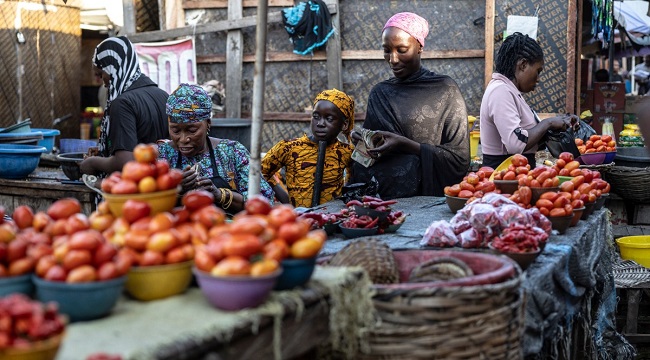
According to the NBS, the food inflation rate stood at 12.12 per cent year-on-year in February 2026, compared with 26.98 per cent recorded in the corresponding period of 2025. Despite the yearly moderation, food prices rose sharply within the month.
“On a month-on-month basis, the food inflation rate in February 2026 was 4.69 per cent, up by 10.70 per cent compared to January 2026 (-6.02 per cent),” the NBS said.
The statistics office attributed the increase to higher average prices of several food items, including beans, carrots, okazi leaf, cassava tuber, crayfish, millet flour, yam flour, snails, and dried ogbono.

Meanwhile, core inflation, which excludes volatile agricultural produce and energy prices, also declined on a yearly basis.nThe report showed that core inflation stood at 15.88 per cent year-on-year in February 2026, compared with 25.66 per cent recorded in February 2025.
However, on a month-on-month basis, the core inflation rate increased to 0.89 per cent, up from a decline of 1.69 per cent in Januaryht