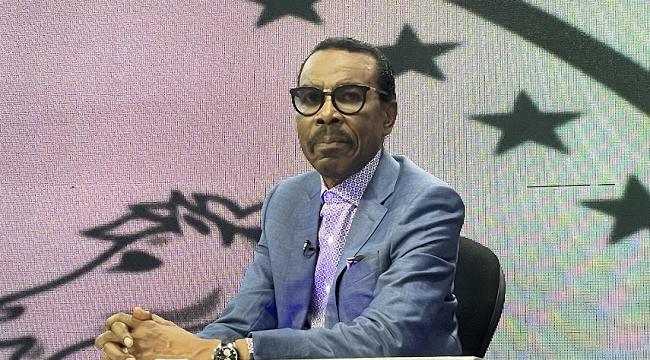
The Chief Executive Officer of Financial Derivatives Company, Bismarck Rewane, has projected a positive business outlook for Nigeria, saying there is rising consumer confidence.
He stated this on Saturday during an economic roundtable tagged “Building with Resilience in the Nigerian Economic Environment,” organised by The Platform.
“The overall consumer outlook is that consumer confidence is rising, suggesting optimism about the economy and potential increasing consumer activity influenced by positive expectations about family income and financial situation,” he stated.
“At the end of the day, it is consumers. The consumer is king, technically speaking. But if your policies are not right, consumers can be the slave; that is why we have consumer protection. We have seen this lately when the Dangote Refinery versus the various importers, tank farms…. What happened? The consumers became king — price war between all of this — at the end of the day, the market became a disciplinarian.”
READ ALSO: Tinubu Seeks World Bank Support To Boost Agriculture, Economic Reforms
Giving a breakdown of African economies, he said Nigeria was making a transition from “command economy to a market-driven economy”.
He said policy makers believe that intervention should be done to bring about stability, rather than creating false outcomes.
Resource-Driven Conflict
During the programme, the economist also weighed in on the conflict trailing some African countries that are rich with mineral resources.
He cited the cases of Liberia and Sierra Leone, as well as the frequent conflicts in the Democratic Republic of Congo, attributing them to the abundance of rich mineral resources.
“Look at the solid mineral map across Nigeria, and you will see the effect of resource nationalism. It is not by coincidence that Nigeria found oil in 1958 in Oloibiri, and by 1966, there was already a war about seceding from Nigeria with the oil.
“It is not a coincidence. There is what we call resource nationalism and the crisis that comes with it. It is not by coincidence that the gold and diamonds in Liberia and Sierra Leone led to the crisis at ECOMOG.
“There is the discovery of resources, and there’s also the crisis that comes with resource nationalism and the political instability that goes with it,” Rewane stated.
Reference Point
Nigeria has become a reference point for the implementation of its economic reforms and their resultant impacts, according to the World Bank Group, which last week sent a delegation to the country.
“Nigeria is a frequent example in my discussions with people around the world—presidents, policy makers, and investors—because I think in these two years, the results that have been achieved are really commendable,” the Managing Director of Operations at the bank, Anna Bjerde, said during a visit to President Bola Tinubu at the State House in Abuja.
Since taking over the reins of leadership in May 2023, President Tinubu has embarked on a raft of reforms, including the removal of the fuel subsidy and the unification of the exchange rate window, among others.
The moves were criticised by opposition leaders, who argued that the sharp impacts of the reforms have pushed millions of Nigerians to the brink.
‘Steady Direction’
However, Bjerde said the implementation of the reforms, coupled with the results, is a subject of discussion among global leaders, investors, and policymakers.
She acknowledged the difficulties in pushing for and implementing the reforms but praised the Federal Government’s commitment to seeing them through.
“What I have particularly appreciated and followed is your steady direction that you communicate to the people of Nigeria, as well as outside of Nigeria, of the importance of the reforms,” Bjerde told Tinubu.
“Even when reform implementation is difficult, there is no turning back. You are staying the course because it is what’s needed to get the results that you’re looking for,” she added.
Upon assumption of office, President Tinubu’s government targeted transforming Nigeria into a $1 trillion economy by 2030.
In July 2024, it launched an operating model and framework for Economic and Financial Inclusion to hit that milestone.
The World Bank says it would retool its budget to align with that dream, which it stated resonates with its economic vision.
Speaking further, Bjerde said, “Under Ajay Banga’s leadership, he wants these strategies to be truly anchored in your vision for your country. So, a $1 trillion GDP and seven per cent growth—that for me now becomes the operating framework that we need to work with. How do we contribute to that vision?”