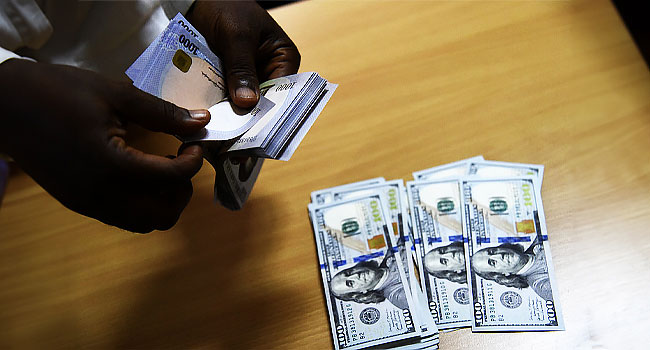
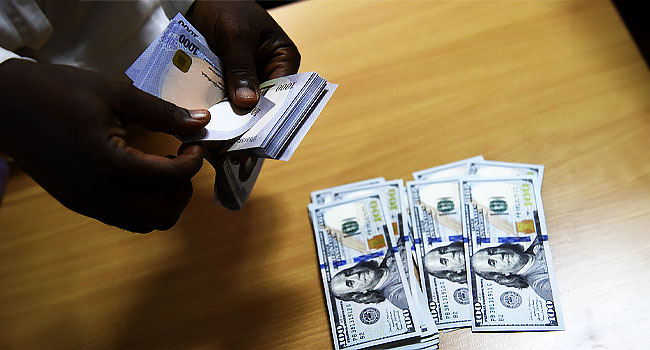
The naira Monday showed signs of stability in the official market, with the dollar trading around ₦1,382 – ₦1,500 at the Nigerian Foreign Exchange Market (NFEM).
Since early March, the Naira has traded within a range of N1,352/$ to N1,398/$. A sustained move above N1,400/$ in the official market could signal a return to 1,450/$.
According to real-time data, the local currency traded at an average of ₦1,382.18 per Dollar as of the morning session, following a closing rate of ₦1,384.25 on Friday, March 27. This signalled a marginal appreciation of 0.15% as trading resumed for the final week of the quarter.
Supported by the Central Bank of Nigeria’s (CBN) refined Electronic Foreign Exchange Matching System (EFEMS), market liquidity remains a key driver of this stability. Turnover at the official window reached approximately $172.9 million in the last full trading session of the previous week.
Again, the external reserves currently holding steady near the $50 billion mark represent a significant recovery from 2024 lows and provide the CBN with ample room to defend the currency against sudden shocks.
High global crude prices, with Bonny Light trading above $103 per barrel, continue to ensure a steady stream of foreign currency inflows.
Headline inflation has shown a sustained downward trajectory, recently recorded at 15.06%. This disinflationary trend, combined with a steady Monetary Policy Rate (MPR) of 26.5%, has bolstered investor confidence in Naira-denominated assets.
Additionally, leveraging advancements in ICT and services sectors, the IMF recently revised Nigeria’s 2026 GDP growth estimate to 4.4%. This macroeconomic optimism effectively sets out a “floor’ for the Naira’s value.
READ ALSO: Iran Strikes Kuwait Power Station Killing One Indian Worker
The US dollar approached a 10-month high and was on track for its biggest monthly gain since July last year, amid conflicting signals from the US and Iran that diminished hopes for a quick resolution to the Middle East conflict.
President Donald Trump stated that Iran’s new leaders have been “very reasonable,’ even as more US troops entered the region and Tehran issued a warning that it would not tolerate humiliation.
This month, the Iranian conflict effectively shut the Strait of Hormuz, a key chokepoint for roughly one-fifth of the world’s oil and gas flows.
Markets reacted sharply, pushing Brent crude toward a record monthly increase. Since early March, the dollar has benefited from its safe-haven status, with higher oil prices negatively impacting Japan and the euro zone but shielding the US.