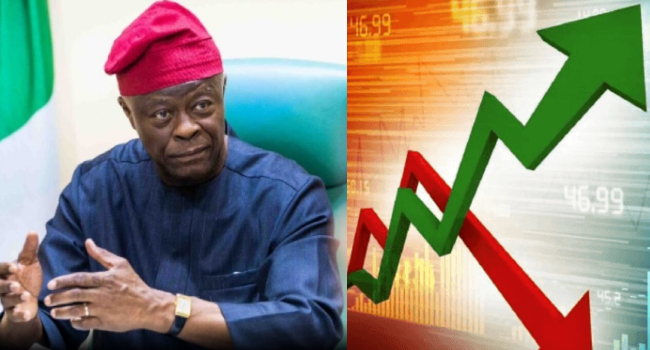
Minister of Finance and Coordinating Minister of the Economy, Wale Edun, has said there may be cuts in the interest rate if inflation keeps cooling.
Edun revealed this during an interview on the sidelines of the Abu Dhabi Sustainability Week, as reported by Bloomberg.
According to Edun, a sustained decline in inflation would create room for additional rate cuts, helping to reduce borrowing costs and easing the government’s debt servicing burden.
Lower inflation and borrowing costs would free up revenue currently spent on servicing debt and improve the fiscal balance, Edun said.
The signal comes at a time when Nigeria’s budget is heavily burdened by debt servicing costs, volatile oil revenues, and a widening fiscal deficit, making any easing in borrowing costs materially important.
A cut in rates could reduce debt-servicing costs and ease pressure on the country’s strained public finances.
Edun, according to Bloomberg, commended the Central Bank of Nigeria (CBN) for what he described as “excellent” progress in curbing inflation, attributing recent improvements to aggressive monetary tightening implemented over the past two years.
The CBN had more than doubled its policy rate from 2022 levels in a bid to rein in inflationary pressures, before implementing a 50 basis-point cut in September that brought the monetary policy rate to 27%.
The move followed a sharp moderation in inflation from its late-2024 peak.
The country’s fiscal outlook remains under pressure. In the proposed 2026 budget, more than a quarter of the N58 trillion spending plan—estimated at about N40 billion—is allocated to interest payments.
Projected revenues stand at around N34 trillion, constrained largely by subdued oil receipts, leaving a budget deficit of roughly N24 trillion, or about 4.3% of GDP. This is wider than the estimated deficit recorded in the previous year.

READ ALSO: NBS To Release Two December Inflation Figures Amid CPI Spike Concerns
Lower interest rates would not only support economic activity but also provide fiscal breathing room for the federal government by reducing the share of revenue devoted to debt servicing.
With oil revenues remaining volatile and deficits widening, Nigeria’s fiscal sustainability is increasingly sensitive to movements in inflation and borrowing costs.
READ ALSO: NIS Updates Passport Tracking System Amid Public Outcry Over Delay
Edun noted that the government’s borrowing strategy would remain flexible and market-driven, with decisions on domestic and external issuances guided by pricing, timing, investor appetite, and adherence to debt limits outlined in the medium-term expenditure framework.
Beyond monetary policy, Edun said the administration is intensifying efforts to boost revenue mobilisation and reduce reliance on borrowing, particularly through structural reforms and improved efficiency in revenue collection.
He noted that the government is rolling out directives requiring ministries, departments, and agencies (MDAs) to halt cash collections and migrate fully to automated payment platforms to improve transparency and reduce leakages.
According to him, the federal government is also counting on privatisation proceeds, divestments by the Nigerian National Petroleum Company (NNPC), and increased crude oil production to support budget funding.