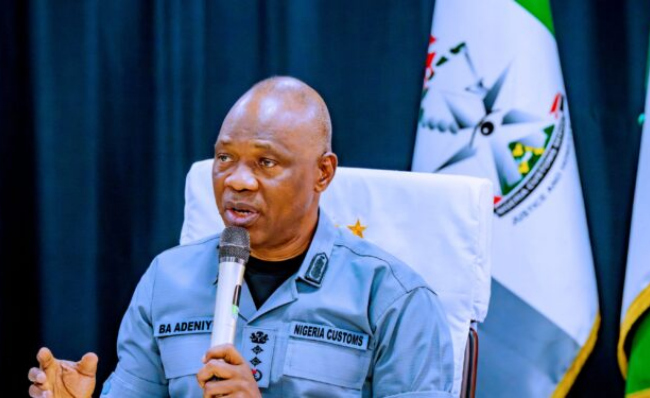
The Nigeria Customs Service revenue collections for 2025 stood at ₦ 7.28 trillion naira, exceeding projection for the year.
Comptroller General of the Service, Adewale Adeniyi, who gave the scorecard at an event to mark the 2026 World Customs Day on Monday, explained that the reported revenue exceeded earlier projected ₦6.5 trillion by 10 per cent.
Adeniyi noted that last year showed very clearly what “protecting society” looks like in the real world.
While speaking further, he noted that officers of the Command uncovered 16 containers of contraband goods in the period under review.
“Across our Commands, officers working with sister agencies disrupted multiple criminal supply chains before they ever reached our communities.
“At Apapa, we uncovered 16 containers of prohibited goods worth over ₦10 billion — a single operation that combined narcotics, expired pharmaceuticals, and concealed firearms.
“At the airports, officers intercepted over 1,600 exotic birds being trafficked without CITES permits, stopping a wildlife crime operation that would have harmed both biodiversity and Nigeria’s international obligations”, the statement said, adding that across land borders, its teams seized illicit narcotics and counterfeit medicines worth hundreds of millions of naira, along with ammunition and other prohibited items moving through covert routes.
“These operations do not make headlines for long, but their impact is enduring as fewer young people exposed to harmful drugs; fewer weapons reaching criminal networks; fewer counterfeit medicines reaching patients; fewer endangered species removed from the ecosystem”.
The Service also said it recorded over 2500 seizures, with an aggregate value of more than ₦59 billion in prohibited and harmful goods removed from circulation nationwide.
These seizures, it noted, cut across narcotics, counterfeit pharmaceuticals, wildlife products, arms and ammunition, petroleum products, vehicles, and substandard consumer goods.
“This most certainly prevented real harm — addiction, unsafe treatment, violent crime, subsidy, exploitation, environmental degradation, and treaty violations and funerals before they occur”, it stated.
READ ALSO: Sahara Boosts Sustainable Development Through MAD Grant Initiative
It, however, advised that vigilance coexists with facilitation.
“A modern Customs administration must be able to detect high-risk consignments without suffocating lawful trade”, it said, adding that the launch of the Time Release Study is significant.
“The TRS marks a major step toward making Nigeria’s trade gateways secure, efficient, predictable, and globally competitive.
“It signals our commitment to move from opinion-driven reforms to evidence-based reforms, and from complaints-driven policy to data-driven policy”.
The Study conducted at Tincan Island Port provides the most
comprehensive measurement of clearance performance in our recent history. It reveals encouraging realities and uncomfortable truths.
It shows, on the one hand, that examination times themselves are relatively efficient, and that Nigeria has the capacity to clear goods quickly.
“It shows, on the other hand, that excessive idle periods—often due to fragmented scheduling, manual documentation, and poor coordination—extend clearance times unnecessarily and erode competitiveness. In other words, our challenge is not that we cannot move goods fast; it is that goods are not allowed to move fast.”
“We now have validated clearance timelines covering more than 600
declarations, combining manual timestamps and platform data.
“We now know with precision how long it takes from booking for examination to physical gate exit, and where bottlenecks concentrate. Armed with such evidence, we are now able to say: the fastest way to protect Nigerian traders and our economy is both through border security and procedural reform”, the Service added.