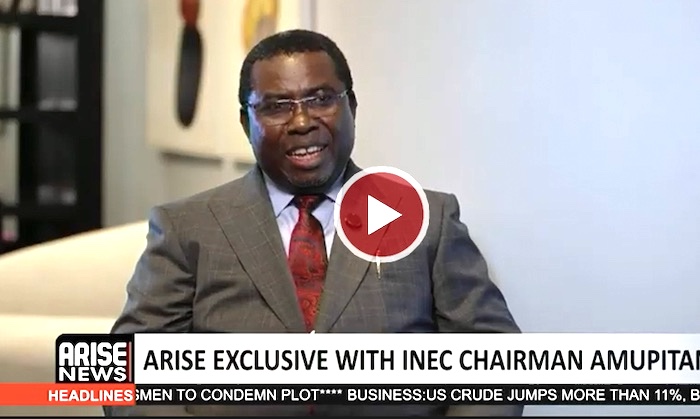
The Chairman of the Independent National Electoral Commission (INEC), Professor Joash Amupitan, has strongly rejected allegations that the electoral body is complicit in plans to entrench a one-party state, insisting that the commission’s actions are strictly guided by the law and existing court orders.
In an interview with ARISE NEWS on Friday, Amupitan pushed back against accusations from opposition parties, particularly the African Democratic Congress (ADC), that INEC had taken sides in its internal leadership crisis.
“I am not guilty as charged, Let me say it very clearly. I am not a party to the plan of anyone to turn Nigeria into a one-party state. By the Constitution of the Federal Republic of Nigeria, Nigeria is a multi-party state, Look at the last election. There were many parties that contested. I think about 10 political parties. In that case, you even had the ADC having five, and PDP winning one. Zenith Labour Party did very well. There are other parties that are existing.”
He stressed that Nigeria’s democratic structure remains firmly multi-party, adding, “By the Constitution of the Federal Republic of Nigeria, Nigeria is a multi-party state.”
Addressing the controversy surrounding INEC’s decision not to recognise any faction within the ADC, Amupitan explained. “The Court of Appeal dismissed the appeal, and at the same time made some preservation orders. The preservation orders were very clear. To the extent that, number one, in view of the fact that INEC had already released its timetable for the election, the intelligence was directed an order to proceed with the case expectations, and this is an originating summons, Then number two, which is now causing the controversy, is the order, specific order, that parties should maintain status quo ante bellum. I did not just stop at that. The parties should not do anything that would force defeat or conflict on the tri-accords. And finally, that we should not, parties should not do anything that would render the proceedings before the Court of Appeals, just like the definite orders of the Court of Appeals.”
Amupitan said the interpretation of status quo ante bellum was central to INEC’s decision-making. “So, if you look at it from that perspective, and there are some difficult decisions to that effect. The status quo is even different from status quo ante bellum. So, when you talk of status quo ante bellum, it means I have to go back. And that was a specific order of action. There is an indication of time here, Yes. When you say status quo ante bellum. At what point will you put the date of that status quo? If you look at it backwards now, you look at it from the viewpoint of when was there a controversy. Controversy started when on the 29th day, July 2025, there was a meeting of NEC, which now ratified the appointment of the deputy national president. So, that’s when we had issues.”
He traced the origins of the crisis to internal developments within the ADC. “Until the controversy came. So, if you look at it backwards now, you look at it from the viewpoint of when was there a controversy. Controversy started when on the 29th day, July 2025, there was a meeting of NEC, which now ratified the appointment of the deputy national president. So, that’s when we had issues. Before that time, what was the position? Now, in this case, the plaintiff went to court on the 2nd of September, 2025. He filed their motions, motion of expertise, motion on notice for injunction, and also filed further motions of expertise on the 15th of December, and motion on notice restraining us, and even stopping them from parading themselves. Those are proceedings.”
According to him, these legal processes created binding constraints on INEC’s actions. “Those are proceedings. Court of Appeals said, don’t do anything that will render any proceeding, whether it is valid, whether it is competent or not, so long as it is filed. Don’t do anything that will render the proceeding nugatory. So, if we are going to take any step, to go and monitor any primaries, there’s an injunction that stops us from going there. To go and monitor any congress, there’s an injunction that is stopping us from going there.”
He revealed that INEC received conflicting communications from opposing factions. “On the 16th day of March 2026, I received two letters. One from the solicitors of Senator David March, requesting me to maintain the status quo, if ever, and not to recognise the other. That’s when I also received another letter from Summit Chambers, the solicitors, that by order of the courts, he was supposed to be recognised as the leader, national leader of ATC, and requesting that I should come down. So naturally, when you receive such communications, you have to refer it first. I call a meeting of the legal department and the EPO, and we look at the facts based on the changes.”
Faced with these contradictions, Amupitan said the commission convened. “So naturally, when you receive such communications, you have to refer it first. I call a meeting of the legal department and the EPO, and we look at the facts based on the changes. The EPM specifically requested that since there was going to be a meeting of the political parties, what do we do in this circumstance? And secondly, that they had received notice of the meeting of NEC of ATC, by David March’s group. So looking on the face of the judgments, and then I felt, okay, what we should do in this circumstance? We are just receiving this case. Invite them. Go ahead, invite them, monitor, whatever. As soon as I did that, I got another letter from Summit Chambers. We didn’t just wake up one day and took this decision. There was something left to it.”
He further disclosed that an existing motion before the Federal High Court. “if you go back to the order of the Court of Appeal, and that was the major concern, if you go back to the order, none of the parties should do anything that puts the situation in a filter. So, it means that, as soon as that motion is pending, if you say somebody does not have a question, it’s already gone to the courts. You have to wait for the court to decide. That is part of what the Court of Appeal was saying. Let the court decide the rights and responsibilities of the parties. So, when I gave that notice to go ahead with the congress and convention, I said that would be breaching that part of the order of the Court of Appeal. None of the parties should do anything that puts a filter on the respect of the subject. And that is part of the belief they are claiming in their regulations. And that is also what they are claiming in their motion as part of the interlocutory ex parte notice. So, given the fact that they are informing me that they are going to hold their congress on the 9th of April, I said, don’t do anything that will affect the subject matter in the Federal High Court. That’s the truth, So, if we are going to take any step, to go and monitor any congress, there’s an injunction that stops us from going there.”
Amupitan warned that disregarding such legal constraints could have far-reaching consequences. “We don’t want to go into a situation where they say, no, don’t do anything, don’t take any step. I have the judgement. It’s very definite. So, if I proceed, for instance, to monitor the application, it means that I’m taking steps that is meant to offend the subject matter, that is pending before the court. I have this accusation that INEC is being used under your leadership to create a one-party state, Well, as far as we are concerned, We don’t want to conduct an election without this early warning. And at the end of the day, after you have won, the court again will come and declare the election invalid. And the implication is that the person with the second highest number of votes will be declared the winner. It happened in Bliatou State during the last election, where after the question of primaries was an issue, and congresses were not held in some states, in some portion of Bliatou State. So, the court said, go and do those primaries. But unfortunately, they did not obey the court order. So, failing to obey the court order has consequences, We don’t want to conduct an election, and at the end of the day, the court again will come and declare the election invalid.”
He cited instances where political parties lost electoral victories due to non-compliance. “Well, as far as we are concerned, INEC is a party in the case, and INEC was sued as a defendant by a member of the leadership. And secondly, you see, the court is very tight. Parties, including David Mark himself, should refrain from doing anything that would face the situation of faith accompanied in court. So, if they are going ahead with their congress, with their convention, it’s left for them to look at it, whether it’s in contravention or not, because INEC did not just take a decision. We didn’t just wake up one day and took this decision. There was something left to it. There was another part: don’t do anything, don’t take any step that would render any proceeding before the court nugatory. And also, that would face on the trial court a situation of helplessness, of faith accompanied. So, if already they’re asking that, don’t do any congress, don’t do any convention, it’s a relief that is being claimed. And especially the final motion for that purpose, that motion has not been detailed. So, if they decide, let me tell you what happened in Zamfira. It happened in the past. We don’t want to conduct an election without this early warning. And at the end of the day, after you have won, the court again will come and declare the election invalid. And the implication is that the person with the second highest number of votes will be declared the winner. It happened in Bliatou State during the last election, where after the question of primaries was an issue, and congresses were not held in some states, in some portion of Bliatou State. So, the court said, go and do those primaries. But unfortunately, they did not obey the court order. So, failing to obey the court order has consequences.”
The INEC chairman also addressed concerns about the commission’s planned voter register revalidation exercise. “Let the court decide the rights and responsibilities of the parties, Now, the opposition parties say that this is a plan to disenfranchise many Nigerians. It’s within the time that is available for that exercise. And the stringent requirement of NIN, when there are many people in rural areas and other parts of the community that have no NIN, The decision to revalidate the voters register was taken even before I became the chairman. The only problem is that it has not been implemented. That is why I have now decided to put it in this year’s budget, so that the exercise will be carried out. Our records for now, if you’re not adding the number that I’ve registered recently, we have about 93 million voters. That record is not great.”
He clarified that the exercise predates his tenure and is intended to improve the credibility of Nigeria’s electoral database. “The decision to revalidate the voters register was taken even before I became the chairman. The only problem is that it has not been implemented. That is why I have now decided to put it in this year’s budget, so that the exercise will be carried out, Our records for now, if you’re not adding the number that I’ve registered recently, we have about 93 million voters. That record is not great.”
He cited the Anambra governorship election as an example. “Let me give you an example. In Anambra State, when we had the governorship election last year, there were about 2.8 million registered voters. And out of the 2.8 million registered voters, only about 600,000 turned up for registration. But there and then, our attention was drawn to certain facts. People were coming to me, they knew of many people that died many years ago. There were so many people that I registered several times. I really wanted to do this before the calendar was introduced in the year 2000. Elections in Nigeria, you’re always having 80%, 90% of voters turned up. But the moment we introduced electronic accreditation, whereby it’s not a situation where you can just go and collect ballot papers, then you started having this issue of reduction in the number of votes. So the 93 million we’re talking about is not realistic. That is the measure locally and internationally to decide whether our election is credible or not.”
Amupitan explained that the validation process would be conducted in phases. ““Now, the validation is going to be two phases. You have the first phase, which has to do with framework, and then engagement with the stakeholders. That is the first phase. Then you have the second phase, which has to do with going to the fields. It has to do with testing and so many other things. Then before the actual exercise. So what we are talking about is even the best-handled framework we have done before. Let’s engage with the stakeholders. And then we see how far we have pushed this process. The meeting this year with all the regs, we look at it and how it’s going to be done. I will agree that it’s a very good exercise. Now, I have received complaints that because of the time, as a matter of fact, during our last meeting, we said we are still going to engage.”
Erizia Rubyjeana
Follow us on: