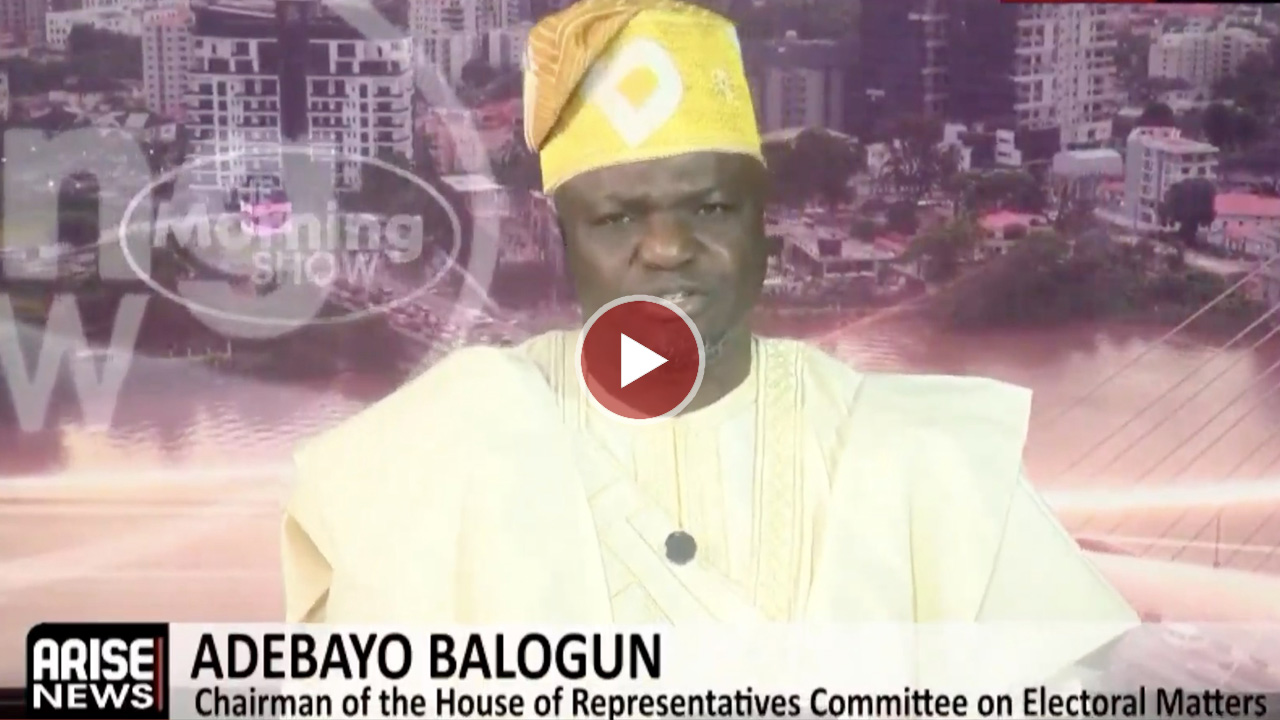
Chairman of the House of Representatives Committee on Electoral Matters, Adebayo Balogun, has said the controversy surrounding the proposed amendment to Section 60 of the Electoral Act centres on what he described as a misinterpretation of the phrase “real time.”
Speaking in an interview on ARISE News on Thursday, Balogun said the debate is not about election integrity but about how “real time” transmission is being understood by the public.
“What has been the contentious for us is, it is about the issue of real time. I think that’s the major problem that we have,” he said.
Balogun explained that during consultations ahead of the House passage of the amendment, no stakeholder raised objections to the inclusion of “real time” transmission. He said the disagreement intensified after the Senate version generated public speculation.
“So, the major contentious word there is in real time,” he stated.
He added: “Taking real time to be at least like a display of results coming in that you’ll be seeing on a dashboard, like when you’re watching CNN.”
According to him, such an interpretation could create fresh controversy if expectations are not met.

“That means, if it doesn’t happen that way, then we’ll have another issue, like we had during the 2022 election, when INEC was accused of over-promising.”
Balogun stressed that real time transmission, in the strict sense, is only possible within a fully electronic voting framework.
“Real-time can only come when you are voting electronically. It is the result you are just transferring, or transmitting, or whatever you decide to use.”
On the functionality of the IReV portal, Balogun rejected the notion that it serves as a public viewing centre.
“So when people call it a viewing center, I find that to be misleading, because you are not going to be viewing it from anywhere. It’s you that must view it. So it’s not a general viewing center.”
He maintained that the legally recognised document remains the physical Form EC8A completed and signed at the polling unit. Reading directly from the Act, he said:
“The presiding officer shall, after counting the votes at the polling unit, enter the vote scored by his candidate on the form to be prescribed by both the commission and the EC8A. The form shall be signed and stamped by the presiding officer and can be signed by the candidate or all the agents who are available at the polling unit. The commission shall electronically transmit the results from each polling unit to the IReV portal in real time. And such transmission shall be done simultaneously with the physical collation of results.”
He urged stakeholders to interpret the law strictly as written.
“Let’s always live by the details of the law. It’s not about what we feel. We don’t bring sentiment to this. We don’t speak before when issues like this arises. And as I said, let’s live with verbatim what it says. Most of the time we only assume and we only think out of what the law is saying.”
Addressing the forthcoming harmonisation between the House and Senate versions, Balogun cautioned against framing the disagreement as institutional rivalry.
“Don’t make it House versus Senate. That’s what we are saying. It’s about what is the better version. What are the issues on ground? When we get to the meeting, there will be discussion. Everybody will present their own facts. And at the end of the day, we’ll take a position.”
He noted that the conference committee would comprise equal representation and decisions would be made through voting where necessary.
Balogun also highlighted the role of the Bimodal Voter Accreditation System, BVAS, describing it as a major electoral safeguard.
“One of the best things that’s actually happening in this process is the BVAS, that ensures accreditation, digital accreditation, biometric accreditation, and that’s the best you can get in any part of the world.”
As debates continue over Section 60, Balogun maintained that clarity, not suspicion, should guide public engagement with the amendment process.
Faridah Abdulkadiri
Follow us on: