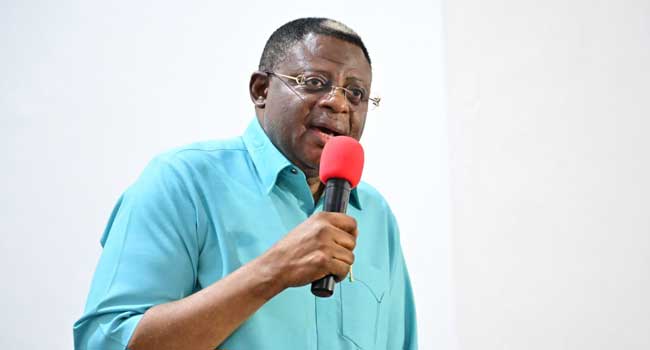
Cross River State Governor, Bassey Otu, on Wednesday presented a proposed ₦987.8 billion budget for the 2027 fiscal year to the State House of Assembly, christening it the “Budget of Consolidation and Renewed Hope”, reaffirming his administration’s commitment to sustainable development, fiscal discipline and inclusive economic growth.
Presenting the estimates in Calabar, Otu described the budget as more than an aggregation of figures, characterising it as “a solemn and sacred pact laden with the trust, expectation and aspiration of the people for their improved livelihoods.”
He said its successful implementation would depend on prudent resource management, accountability and disciplined public expenditure, underscoring his administration’s determination to translate its social contract with the people into tangible improvements in their living conditions.
The proposed budget, valued at precisely ₦987,808,089,235.92, represents an increase of approximately 2.57 per cent over the 2026 budget.
Capital expenditure accounts for ₦708.43 billion, representing 71.72 per cent of the total provision, while recurrent expenditure stands at ₦279.38 billion, or 28.28 per cent.
The substantial capital allocation, according to the governor, reflects the government’s determination to prioritise infrastructure, human capital development and productive investments capable of stimulating economic activity.
Otu explained that the 2027–2029 Medium-Term Expenditure Framework and Fiscal Strategy Paper provided the foundation for the estimates, adding that the budget would sustain ongoing programmes while opening new pathways for investment, employment creation and improved public services.
“The imperative of this exercise underscores our collective resolve to chart a sustainable course for the growth and development of our dear State,” he declared.

Addressing concerns surrounding the state’s debt profile, the governor maintained that his administration had refrained from obtaining fresh domestic and external loans since assuming office in 2023.
Citing verifiable indices from the National Bureau of Statistics and the Debt Management Office, he said Cross River remained among the few states that had not contracted new loans during the period.
He attributed the state’s existing debt burden to obligations inherited from previous administrations, explaining that debt servicing had constrained the pace at which available resources could be deployed to development projects.
He further clarified that the naira value of external debt had been affected by currency devaluation and foreign-exchange liberalisation.
“I cannot, and will never mortgage the future of our children with unsustainable loans,” Otu declared, pledging to strengthen internally generated revenue, maximise federal allocations and attract development assistance and private-sector investment to finance the state’s development priorities.
Reviewing the performance of the 2026 budget, the governor acknowledged the pressures of exchange-rate volatility, rising operational costs, supply-chain disruptions and inherited debt obligations.
He disclosed that the administration had collaborated with the legislature to enact a supplementary budget, raising the spending framework to ₦963.07 billion to accommodate urgent interventions and counterpart-funding requirements.
Among the achievements highlighted was the delivery of more than 608 kilometres of interconnected road projects across the three senatorial districts, including the Nsan–Oban Road in Akamkpa, the Adiabo–Ikoneto Road in Odukpani and the Yahe–Ebo–Wanakade Road in Yala.
He also reported progress in rural electrification through solar streetlights, mini-grids and network rehabilitation, describing the interventions as essential to reopening economic corridors, improving mobility and restoring commercial activity in underserved communities.
Agriculture featured prominently in the governor’s account of the administration’s economic transformation agenda. Otu disclosed that more than 20,000 bags of fertiliser had been distributed to 8,000 farmers, while over one million improved oil-palm, cowpea and cocoa seedlings had been provided to farmers across the state.
He also highlighted the establishment of a 50,000-hectare rice project and support for more than 5,300 livestock farmers, alongside loans, grants and agricultural machinery for smallholder and large-scale producers.
According to him, an ₦18 billion offtake arrangement had helped advance the state’s agricultural initiatives, while the cash-crop revolution was strengthening the productive capacity of farmers.
“There is no food security without agriculture,” he asserted, adding that the government intended to become Nigeria’s leading cocoa and oil-palm-producing state through expanded cultivation, mechanisation, agro-allied industries and private-sector partnerships.
On healthcare, education and public-sector welfare, Otu outlined interventions designed to improve access, strengthen institutions and enhance service delivery.
He cited the renovation and rehabilitation of hospitals, the establishment of medical oxygen plants in Calabar and Ogoja in partnership with UNICEF, and the upgrading of state-owned Schools of Nursing and Midwifery to accreditation standards.
He also highlighted a reported 95 per cent routine immunisation coverage, implementation of the Consolidated Medical Salary Structure for medical workers and an increase in the retirement age of health workers from 60 to 65 years.
In education, he said the state had deployed more than ₦17 billion in Universal Basic Education Commission intervention funds, supported classroom construction and rehabilitation, paid WAEC examination fees for 43,694 Cross River State indigenes and approved the promotion of more than 14,000 teaching and non-teaching staff.
The government, he added, was targeting a literacy rate of 98 per cent from the current estimated 80.7 per cent, while strengthening technical and vocational education to equip young people with employable and entrepreneurial skills.
The 2027 estimates also assign prominent roles to aviation, transportation, maritime development and tourism in the state’s economic diversification strategy.
The governor disclosed the integration of a new Bombardier CRJ regional jet into the state’s aviation assets, bringing the fleet to five aircraft, alongside accelerated construction work at the Obudu International Passenger and Cargo Airport.
He further highlighted the acquisition of 730 electric vehicles, comprising inter-city and metropolitan buses, tricycles and motorcycles, to reduce commuting costs and support cleaner transportation.
On the maritime front, he said the Bakassi Deep Seaport had secured the Federal Government’s approval and Certificate of Compliance and was awaiting the commencement of construction, with anticipated private investment of approximately $3.5 billion.
He also cited the federal government’s formal re-accreditation of Cross River as a littoral state, describing it as a strategic development for the state’s maritime ambitions.
“Our overall target in this sector is to transform our aviation business model into a highly profitable and self-sustaining revenue asset for the State,” he said.
Infrastructure receives the largest explicitly listed sectoral allocation of ₦246.1 billion, followed by education with ₦99.6 billion, health with ₦85.4 billion, agriculture with ₦28.2 billion and aviation with ₦21.8 billion.
Other provisions include ₦20.2 billion for the House of Assembly, ₦19.1 billion for the judiciary, ₦16.6 billion for power and ₦11.3 billion for tourism.
The governor said the budget would continue to align with the United Nations Sustainable Development Goals, ensuring continuity in unfinished projects and directing resources towards the state’s strategic priorities.
He also pledged continued investment in forest conservation and the green economy, judicial infrastructure, security and youth empowerment.
In education, he reaffirmed the policy of free and compulsory education from primary to junior secondary school, alongside the payment of WAEC fees for public-school students.
On the judiciary, he promised adequate funding for ongoing court projects and further improvements in the working conditions of judicial officers, while urging the institution to pursue reforms that would strengthen public confidence in justice delivery.
Concluding his presentation, Otu pledged to sustain a government that is responsive to the needs of citizens, prudent in the management of public resources and accountable to the electorate.
He emphasised the importance of harmonious relations among the executive, legislature and judiciary, describing institutional cooperation as indispensable to peace, stability and shared prosperity.
The governor formally sought the Assembly’s consideration and timely passage of the proposed ₦987.8 billion Appropriation Bill, expressing confidence that its implementation would accelerate economic growth and improve the welfare of Cross Riverians.
“My administration shall continue to be responsive to the yearnings of the citizenry, prudent in the management of the State’s resources and accountable to the people,” he assured.
He subsequently presented the estimates under the banner, “Budget of Shared Prosperity,” calling on lawmakers and other stakeholders to work collectively towards building a more prosperous, inclusive and economically resilient Cross River State.