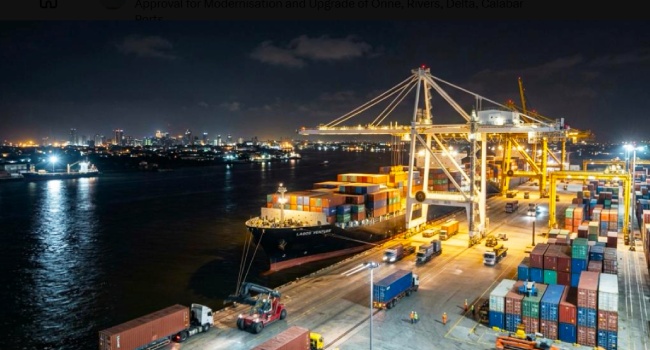
In a major boost to Nigeria’s maritime infrastructure, the Federal Government has greenlit the comprehensive modernization of the Onne, Rivers, Delta, and Calabar ports.
Disclosing this on his X handle, Minister of Marine and Blue Economy, Adegboyega Oyetola, said that the approval builds on the earlier approval for the modernisation and upgrade of Apapa and Tin Can Island Ports in Lagos.
According to him, the decision reflects the President Bola Tinubu administration’s determination to develop a balanced, efficient and globally competitive national port system.
Oyetola explained that under the leadership of Tinubu, infrastructure renewal and economic diversification remain central to the Renewed Hope Agenda.
He added that modern and efficient ports are critical to this vision because they facilitate trade, support industry, attract investment and create jobs.
“Extending the modernisation programme beyond Lagos will complement ongoing investments in Apapa and Tin Can Island, while helping to reduce the concentration of cargo traffic around Lagos and creating additional efficient gateways for international trade,” said Oyetola.
“Upgraded infrastructure and improved operational efficiency at Onne, Rivers, Delta and Calabar Ports will enhance cargo handling, reduce vessel turnaround times, strengthen regional connectivity and make the movement of goods more predictable and cost-effective.”
The minister further stated that the ports have strategic roles to play in our trade, industrial and regional development, with the administration determined to equip them to meet the demands of a growing economy.
“This is part of a broader expansion of Nigeria’s maritime infrastructure, including Federal Government approvals for the development of the Ibom, Bakassi, Agge, Gateway, Ondo and Bonny Deep Seaports,” he said.
“Our approach is comprehensive. We are modernising existing ports while facilitating the development of new deep seaports. Together, these investments will expand Nigeria’s maritime capacity, create stronger economic corridors and position our country as a major maritime and logistics hub in Africa.”
“Our vision is an integrated maritime and logistics system in which ports, roads, rail, inland waterways and other transport infrastructure work together to enable the seamless movement of cargo.
“We want Nigerian businesses to spend less time and resources moving their goods, while creating an environment that encourages investment and supports job creation,” the minister added.
Oyetola also said that the ministry would continue to work closely with state governments, terminal operators, investors, shipping companies and other stakeholders to ensure that the projects translate into tangible improvements across Nigeria’s marine and blue economy.
He stated that while Nigeria has the geography, market and maritime resources to become a leading maritime hub, the Federal Government’s responsibility is to provide the infrastructure, policies and enabling environment required to turn that potential into sustainable economic value.
World Bank Ranking
The latest approval comes more than three months after the World Bank named the Lagos Port in Apapa and Tin Can Island Port among the world’s top 20 most improved container ports over the last five years.
The global bank, in its Container Port Performance Index (CPPI) for 2025, listed Tin Can Island Port Complex and Apapa Port complexes in the category of Top 20 Port Improvements.
It followed the Nigerian Port Authority’s frontline contribution to the sustenance of National Trade Surplus through provision of the platform for Nigeria’s successive attainment of trade surplus year-on-year since 2024 and, most recently, that of N7.54 trillion in the first quarter (Q1) of 2026 as reported by the National Bureau of Statistics (NBS).
The report, compiled by the World Bank and S&P Global Market Intelligence, ranked Tin Can Island Port 10th globally among ports that posted the highest improvements between 2020 and 2025, while Lagos Port was 12th on the list.
According to data from the report, Tin Can Island Port improved its CPPI score by 42 points, moving from a score of -68 in 2020 to -26 in 2025, while Lagos Port also recorded a notable improvement of 35 points, rising from -61 in 2020 to -26 in 2025.
The performance placed Nigeria among a select group of countries that have made substantial progress in enhancing vessel turnaround times, port efficiency, and cargo handling operations over the past five years.
During his State Visit to the United Kingdom on March 19, 2026, President Tinubu witnessed the signing of a £746 million financing agreement in London between Nigeria’s Ministry of Finance and Citi Bank, aimed at modernising Apapa and Tin Can Island ports in Lagos.