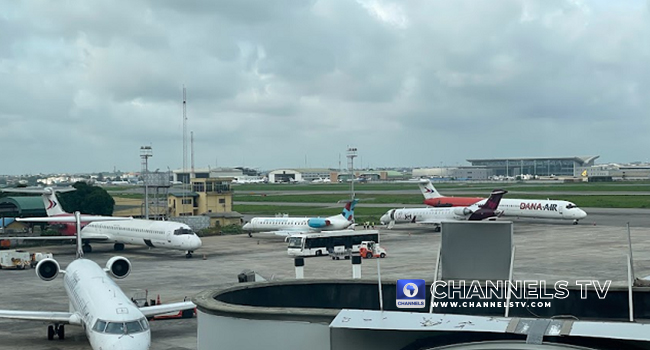
Amid the rise in the cost of aviation fuel, the Federal Government has appealed to airline operators to exercise restraint with respect to any proposed increase in airfares or suspension of air operations.
READ ALSO: Marketers Blame Jet A1 Price Hike On Middle East Crisis, Fault AON’s ₦3,300/Litre Claim
In a letter addressed to the Airline Operators of Nigeria (AON) and signed by the Minister of Aviation and Aerospace Development, Festus Keyamo, it said it was aware of the “sudden hike” in Jet A1 fuel from ₦900 per liter as at February 28, 2026, to ₦3,300 per liter as of April 16, 2026, representing a 300 per cent increase.
The government said that while the prevailing cost mounts pressure on private air operations, any immediate upward adjustment in ticket prices would impose significant hardship on the travelling public, potentially depress demand, and limit accessibility to air transport for a broad segment of Nigerians.
“Secondly, I appeal for the reconsideration of any planned suspension of flight operations. Such action would have far-reaching adverse implications for the national economy, disrupt critical mobility and logistics networks, erode public confidence, and undermine the progress recorded under the ongoing reforms within the aviation sector,” Kayamo said in the letter.
He, however, disclosed that a high-level emergency stakeholders’ meeting had been scheduled to be held on Wednesday, April 22, 2026, in Abuja, bringing together all relevant stakeholders and regulatory authorities with a view to achieving a prompt, practical, and sustainable resolution.
The minister noted that the venue and time would be communicated in due course.
While commending the resilience, professionalism, and steadfast commitment of air operator in sustaining air transport services under evidently difficult conditions, he reiterated that the administration of President Bola Tinubu accords the aviation sector the highest strategic importance.
“In line with the provisions of the Civil Aviation Act, 2022, the sector remains a critical national asset essential to trade facilitation, national security, employment generation, and overall economic integration. You will also acknowledge that the Government of President Bola Ahmed Tinubu has initiated unprecedented reforms in the sector aimed at supporting the growth and sustenance of the businesses of local operators.
“I wish to formally assure you that the concerns raised by your members have received the full attention of the Federal Government, and we shall take immediate steps to address the issues,” the minister added.
Threat of Shutdown
Airline operators had warned that airlines across the country might suspend operations from April 20, 2026, over what they described as an “astronomical and unsustainable” rise in the price of Jet A1 fuel.
In a letter dated April 14, 2026, to major energies marketers, the operators, under the AON, said the cost of aviation fuel has surged from ₦900 per litre as of February 28 to ₦3,300 per litre — an increase of over 300 per cent within weeks.
According to the body, the spike is “artificial” and far exceeds global trends, noting that international crude oil prices have risen by only about 30 per cent within the same period.
“Airline revenues are insufficient to cover the cost of fuel alone,” the letter stated, adding that the situation has deteriorated to the point where continued operations are no longer viable.
The group warned that the actions of fuel marketers are “decimating the aviation industry” and pose broader risks to Nigeria’s economy, safety, and national security.
The AON revealed that the impact of the price surge is already being felt across the sector, disclosing that one airline had grounded all operations since March 13, 2026, due to the rising cost of fuel.
Marketers Fault ₦3,300/Litre Claim
But major oil marketers attributed the spike in aviation fuel prices to global geopolitical tensions, particularly ongoing conflicts in the Middle East, which have disrupted supply chains for middle distillates such as diesel and Jet A1.
“The challenge is that the ongoing geopolitical tensions in the Middle East have severely disrupted global supply chains and significantly affected the pricing and availability of middle distillate products such as diesel and Jet A1. Transport costs within the country have therefore gone up by an average of 50 per cent,” the Major Energies Marketers Association of Nigeria (MEMAN), said in a statement signed by its Executive Secretary and Chief Executive Officer, Clement Isong.
The association explained that aviation fuel distribution involves stricter safety and handling requirements compared to other petroleum products, contributing to higher operational costs.
“It is also important to note that the transportation and distribution of ATK is governed by specific protocols for quality assurance and safety reasons, which are more stringent than those applicable to most other petroleum products. Dedicated equipment, specialised handling procedures, and rigorous quality checks at every stage of the supply chain are non-negotiable requirements. These necessary safeguards inherently make the logistics and distribution of ATK a more cost-intensive undertaking compared to other petroleum products,” it said.
Responding to claims that aviation fuel has surged from ₦900 per litre as of February 28 to ₦3,300 per litre, MEMAN expressed surprise.
It added that its market survey indicates more competitive pricing exists, and that members remain committed to fair, market-reflective rates.
MEMAN also urged airline operators to adopt longer-term supply contracts rather than relying on spot purchases, saying this would help stabilise pricing and cash flow in the aviation sector.