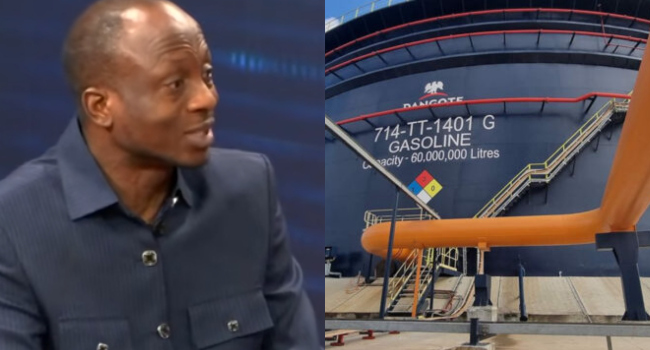
Chief Economist at SPM Professionals, Dr. Paul Alaje, has advised the Federal Government to partner with the Dangote Petroleum Refinery in providing palliatives to the masses following the escalation in the ongoing war between Iran and the United States.
He gave the advice when he appeared as a guest on Channels Television’s The Morning Brief on Monday.
According to him, returning the price of Premium Motor Spirit (PMS) or petrol to ₦800 per litre before the war would go a long way in ameliorating suffering among Nigerians.
“Before the war, Dangote Refinery had slashed prices to ₦800 per barrel. Now that prices are soaring, what that means is that the costs of living will keep soaring, and food prices will escalate. “We have seen governors such as Seyi Makinde announcing some sort of ₦10,000 support. It’s something, even though relatively small. We encourage other states to do the same.
“What we should do is partner with Dangote. What was the cost of crude to Dangote before the war? Can we maintain that price as a subsidy to Nigerians? And then instruct that for everybody who is buying from Dangote, there should be a specific price at which the products should be sold.
“We can now deliberately reduce oil theft, which is a gap nobody wants to talk about. Can we deliberately stop oil theft, even if it is just for this period that everybody is going through hardship? Then take all of those crude and give them to Dangote for refining so that prices can go back to what they were before the war?
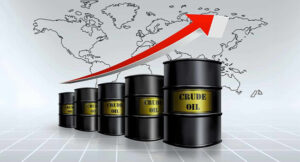
Oil Prices Soar
His advice comes as oil prices rallied, and stocks tumbled again Monday as the Middle East crisis escalated with the entry of Houthi rebels into the Iran war, and investors grew increasingly concerned the United States would send in ground troops.
READ ALSO: Crude Surges, Stocks Fall As Houthi Attacks Escalate Iran War
As the conflict moved into its fifth week, the spectre of a widening conflict grew as Yemen’s Houthi rebels on Saturday said they had fired “a barrage of cruise missiles and drones” at strategic sites in Israel.
The strikes raised concern about the war spreading to the Red Sea, with Saudi Arabia rerouting much of its oil exports there to avoid the Strait of Hormuz, through which 20 percent of crude and gas passes and has been effectively closed by Tehran.
The news sent the price of oil to its highest level since earlier in the month after the United States and Israel began their campaign against Iran. Both main contracts jumped more than three percent at one point, with Brent hitting close to $117 a barrel.
Alaje, however, warned that the price of petrol could climb above ₦1500 if the war continues unabated.
“What we know now is that America has said it is making efforts to talk with Iran on how to end the war.
“But whether that will be the case is another kettle of fish. The war is still ongoing, and the price of Brent crude is climbing to about $110 per barrel.
“If it gets to $120, one of the implications is that Nigerians will be buying PMS above $1,500 per barrel, approximately N1,600. That also has an implication that will double the cost of transportation before the pre-war.
“So, do I think the war will stop soon? I hope it stopped yesterday. But with the activities I see around the Middle East, I doubt. President Trump has even said that they don’t even know who they are talking to.
“This war has major implications for gas supply. Just yesterday, we saw what we can call a notable delay of flights from Nnamdi Azikiwe Airport to other airports. It blamed the delay on operational reasons, but data aggregation noted that Jet-A1 rationing may be one of the reasons for the delay.
“So the war is already affecting everyone. But if the war prolongs and the US targets the Iranian oil, Nigerians should be ready to pay more for diesel. It will grow more from what it is now to about N2,000 per litre.
“That means you will pay more for production, pay more for finished goods, and the one we are importing will get hit by global inflation”, he said.
He noted that the National Bureau of Statistics (NBS) inflation rate for February would definitely climb to about 16 per cent due to the war.
“Already, we should expect the war to have an impact on the inflation rate for February, which we should expect to be about 16 per cent above what was reported in January, slightly above 15 per cent, and prices of commodities have started going up”, he said, adding that the government needs to introduce more economic reforms.
More Reforms
He called on the Federal Government to introduce more economic reforms.
“Nigerian government needs to come up with reforms, not just subsidy removal, unification of the naira, and tax reforms.
“We now need reforms in industrial output to target major improvements in output. We need major reforms on energy- that is, electricity supply, and of course, major reforms on Agriculture. “And if I can anchor it, we need major reforms on the railway- voting more money to it and connecting it to farms and city centres where major consumption takes place, and even to industrial centres.
“We also need reforms in the oil and gas sector. We can’t make gains if we do less than 2 million barrels per day. We should be doing about 60 million barrels”, he said.