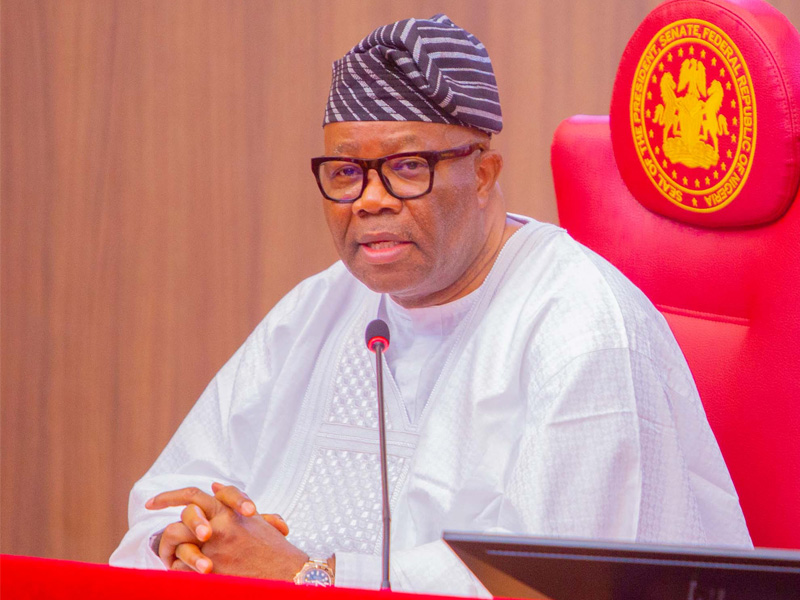
Senate President Godswill Akpabio has dismissed criticisms surrounding the Senate’s amendment of the Electoral Act, insisting that commentators and civil society actors are misjudging the legislature due to an incomplete legislative process and misunderstanding of parliamentary procedures.
Akpabio spoke in Abuja as special guest of honour at the unveiling of the book, The Burden of Legislators in Nigeria, authored by Senator Effiong Bob.
Addressing concerns over the removal of the phrase “real-time” electronic transmission of election results, Akpabio clarified that the Senate has not concluded work on the bill and that public debate is premature.
“The Electoral Act amendment is incomplete. We have not completed it, but they are already on television. They don’t understand lawmaking. They don’t even know that what is in the Senate is not completed until we look at the Votes and Proceedings,” he said.
Explaining the legislative process, Akpabio said the Votes and Proceedings stage allows senators to correct, amend, or clarify decisions taken on the floor before final approval.
“When we bring out the Votes and Proceedings, any senator has a right to rise and say, ‘On clause three, this was what we agreed upon.’ That is the only time you can talk about what the Senate has done or not done,” he added.
Akpabio criticised commentators for what he described as “abuse” of the legislature, accusing some civil society actors of attempting to impose their views on lawmakers.
“People have become mouth legislators. Go and contest election if you want to talk about lawmaking and go and join them and make the law. Retreats are not lawmaking; retreats are part of consultations. So why do you think that the paper you agreed in Lagos during a retreat must be what is agreed on the floor?” he asked.
He emphasised that the Senate had not removed electronic transmission of election results, only questioned the requirement for real-time transmission.
“I must state clearly, without ambiguity, that the Senate has not removed any means of transmission. If you want to use a bicycle to carry your votes from one polling unit to the ward centre, do so. If you want to use your phone to transmit, do so. If you want to use your iPad, do so,” Akpabio said.
He explained that mandating real-time transmission could create legal disputes if network failures occurred during elections.
“All we said was that we should remove the word ‘real time,’ because if you say real time and there is grid failure and the network is not working, when you go to court somebody will say it ought to have been real time,” he said.
Akpabio added that the Independent National Electoral Commission (INEC) should determine the mode and timing of result transmission within the framework of the law.
“Real time means that in over nine states where networks are not working because of insecurity, there will be no election results. Nationally, if the national grid collapses and no network is working, no election results will be valid,” he warned.
Citing a Supreme Court ruling, he said Nigeria’s inadequate infrastructure limits electronic transmission, which remains supplementary to statutory collation.
“The result is in Form EC8A. It will be carried from the polling unit to the ward centre, from there to the local government collation centre, to the senatorial collation centre, to the state collation centre, and finally the national collation centre,” he explained.
Akpabio stressed that the bill had not completed the bicameral legislative process, and a conference committee will reconcile differences between the Senate and House of Representatives versions before final passage.
“It is only when we have finished that that you will now say the National Assembly has passed any amendment to the Electoral Act,” he said, urging critics to allow the process to run its course and warning against attempts to “rubbish the process” before its conclusion.
He further emphasised that electoral reforms must match Nigeria’s institutional and technological capacity.
“We insist that electoral reforms must be anchored in law, guided by capacity, secured against abuse and applied uniformly across the nation. Technology must serve democracy; it must not endanger democracy,” Akpabio said.
“You stay in a place that has no wire, no light, and you want to put in the law ‘real time.’ Progress must not bring about injustice,” he added.
Warning that misunderstanding legislative processes could weaken democracy, he said:
“When people do not understand their legislature, democracy is at risk. Democracy is measured not by passion alone, but by principles.”
Akpabio recalled that the current Electoral Act enabled competitive elections in 2023, including losses by the then-ruling party in key states.
“This same Electoral Act made the incumbent party almost lose millions of votes. We lost in places like Lagos and Kano. New parties won whole regions with the same act, whether real-time electronic transfer or not,” he said.
He concluded: “You don’t make law for an individual or for opposition. You make law to outlast you, for generations unborn.”
Earlier, the National Chairman of the African Democratic Congress (ADC) and former Senate President, Senator David Mark, urged the National Assembly to pass the bill and allow INEC to determine its implementation.
“What the ADC is saying is, pass the law. Let INEC decide whether they can do it (real-time electronic transmission) or not. Don’t speak for INEC. The stand of ADC is clear; pass the bill and let INEC decide on what it will do with it,” Mark said.
Speakers at the event, including Akwa Ibom Governor Pastor Umo Eno and book reviewer Professor Maxwell Gidado SAN, praised Senator Bob’s courage in highlighting the challenges Nigerian legislators face.
Senator Bob outlined challenges such as electoral battles, conflicts with governors and political godfathers, judicial cancellations of victories, addressing constituents’ private issues, and self-inflicted obstacles.
“The courage to defend democracy is in the legislature and the legislators,” he said.
Boluwatife Enome
Follow us on: