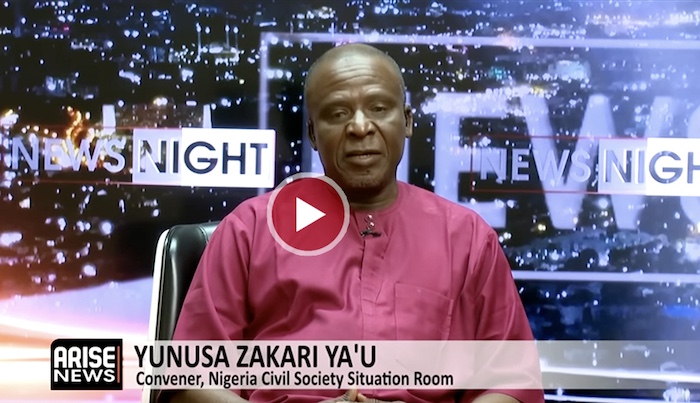

Convener of the Nigeria Civil Society Situation Room, Yunusa Zakari Ya’u, has warned that Nigeria risks repeating past electoral failures if the Senate does not urgently pass the Electoral Act Amendment Bill, describing the delay as a refusal by lawmakers to learn from history.
Speaking in an interview with ARISE News on Tuesday, Ya’u said the National Assembly has had multiple opportunities to avoid last-minute electoral reforms but has consistently failed to act decisively.
“I wouldn’t say it is incompetence. I would say we are refusing to learn,” Ya’u said.
“We saw what happened in previous cases, in 2015 and 2019. We expect that any learning legislative body would learn lessons from those instances and take corrective measures.”
He stressed that the most critical corrective step now is the speedy passage of the amendment to allow sufficient time for presidential assent and proper implementation.
“The corrective measures are essentially to ensure that they quickly, speedily pass the amendment so that the President can assent to it,” he said.
“It is important to call on them and tell them that they have a responsibility to this country and to themselves to enact a law that will improve the conduct of elections in Nigeria.”
Ya’u said democratic-minded Nigerians and civil society groups are united in demanding immediate legislative action once the Senate resumes.
“Every meaningful Nigerian, every democratic-minded person, should add their voice that the amendment must be passed as soon as they resume,” he said.
“I understand that they will be resuming early next week, and we hope that within those few days they should be able to go through the process and get the bill passed.”
He added that the President must also act without delay once the bill reaches his desk.
“We also hope that the President will not take any unnecessary long period in going through the bill, but ensure everything is in order, append his signature and return it.”
Addressing concerns that the Independent National Electoral Commission (INEC) may be running out of time under the existing legal framework, Ya’u insisted that the proposed amendments remain essential.
“The amendments are extremely important, learning from the previous Electoral Act,” he said.
“There are many innovations in the amendment, including electronic transmission of results.”
He said the bill also strengthens INEC’s independence and oversight responsibilities.
“There are provisions for improved autonomy and funding of INEC,” Ya’u said.
“There is also improvement in terms of INEC’s supervisory role in monitoring the conduct of party primaries.”
While acknowledging the legal pressure on INEC due to election timelines, Ya’u suggested flexibility rather than abandoning the reforms.
“If it reaches a point where INEC is in a difficult position, one option could be to reduce the number of days,” he said.
“But we should not throw away the innovations because of timelines.”
Ya’u said civil society organisations will continue to press lawmakers until the bill becomes law, stressing that the credibility of the 2027 general elections depends on it.
“Civil society will continue to voice its position that this Electoral Amendment Bill must be passed as quickly as possible,” he said.
“The conduct of the 2027 elections must be based on this new Electoral Act that will result from the amendment.”
He warned that failure to act decisively could once again undermine public trust in Nigeria’s democratic process.
Boluwatife Enome
Follow us on: