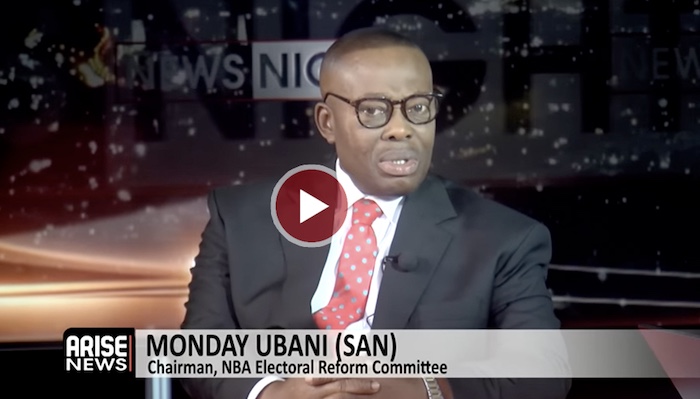

Chairman of the Nigerian Bar Association (NBA) Electoral Reform Committee, Monday Ubani, SAN, has said the Electoral Act Amendment Bill is critical to Nigeria’s 2027 general elections, warning that without it, key election timelines cannot be properly determined.
Speaking in an interview with ARISE News on Tuesday, Ubani said expectations remain high that the Senate will prioritise the bill immediately upon resumption from its December recess, despite concerns over delays.
“They proceeded on vacation during the December period, and they are resuming this January. Upon resumption, one of the top priority bills pending passage is this Electoral Amendment Bill,” Ubani said.
“It is the hope of every stakeholder in the electoral process that this bill is passed because without the legal framework, you cannot determine the timetable of the election itself for next year.”
The House of Representatives passed its version of the amendment bill in December 2024, but the Senate has yet to act on it. Ubani said once the Senate concludes consideration, both chambers will harmonise their versions before transmitting the bill to the President for assent.
“When the Senate passes theirs, if there are any differences, they will harmonise the bill and send it to the President for assent,” he said.
“I do not have any doubt in my mind, going by my interaction with stakeholders, especially in the Senate, that they will give it priority.”
Ubani explained that a major focus of the proposed amendment is the restructuring of election timelines, including shortening periods for election disputes and potentially resolving litigation before winners are sworn in.
“Timeline was not only considered with the issue of leadership but also electoral disputes,” he said.
“Some of the days within which you can challenge election results have been limited. In fact, what is being mooted is whether we can even finish electoral disputes before swearing in whoever emerges as the winner.”
He said one of the most significant reforms is making real-time electronic transmission of results mandatory, removing ambiguities that plagued the 2023 elections.
“You are aware of the issue of real-time transmission, which is very critical,” Ubani said.
“This time around, it should not be treated as a guideline. It must have some level of compulsion. Once results are counted at the polling unit, they must be transmitted.”
Ubani noted that the amendment seeks to address gaps in the 2022 Electoral Act that allowed inconsistent judicial interpretations.
“There were so many ambiguities in 2022, especially when it came to interpretation by judicial officers,” he said.
“Those ambiguities are being removed by making what were regarded as guidelines now compulsory, including digitisation, BVAS and online transmission to IReV.”
Ubani also disclosed that the bill strengthens the powers of the Independent National Electoral Commission (INEC), particularly in monitoring party primaries.
“More powers have been given to INEC, especially in monitoring the entire electoral process, starting from party primaries to the election itself,” he said.
“The voters’ list and delegates’ list must be publicised. You cannot go and hire touts from the park to come and vote. It must be party members whose names are in the register.”
He said INEC’s guidelines will now carry stronger legal backing.
“Before now, some INEC rules were said not to be recognised under the law,” Ubani said.
“But now, whatever guidelines INEC makes have constitutional backing, and that is very important.”
Ubani further revealed that the amendment proposes a reduction in campaign duration to limit prolonged political spending.
“Almost a year before elections is too long. It puts aspirants into unnecessary expenses,” he said.
“Campaigns for the presidential election will likely begin around November, with elections in February, reducing the time and cost of campaigning.”
Addressing concerns that the Senate lacks urgency, Ubani insisted the delay is not intentional.
“The Senate is not in any way delaying this bill intentionally to hurt the system,” he said.
“The delay was largely because of the holiday, and immediately upon resumption, the bill will receive priority attention.”
The Electoral Act Amendment Bill is expected to play a decisive role in shaping Nigeria’s 2027 elections, with legal experts and civil society groups warning that further delays could constrain INEC’s preparations and undermine public confidence in the process.
Boluwatife Enome
Follow us on: